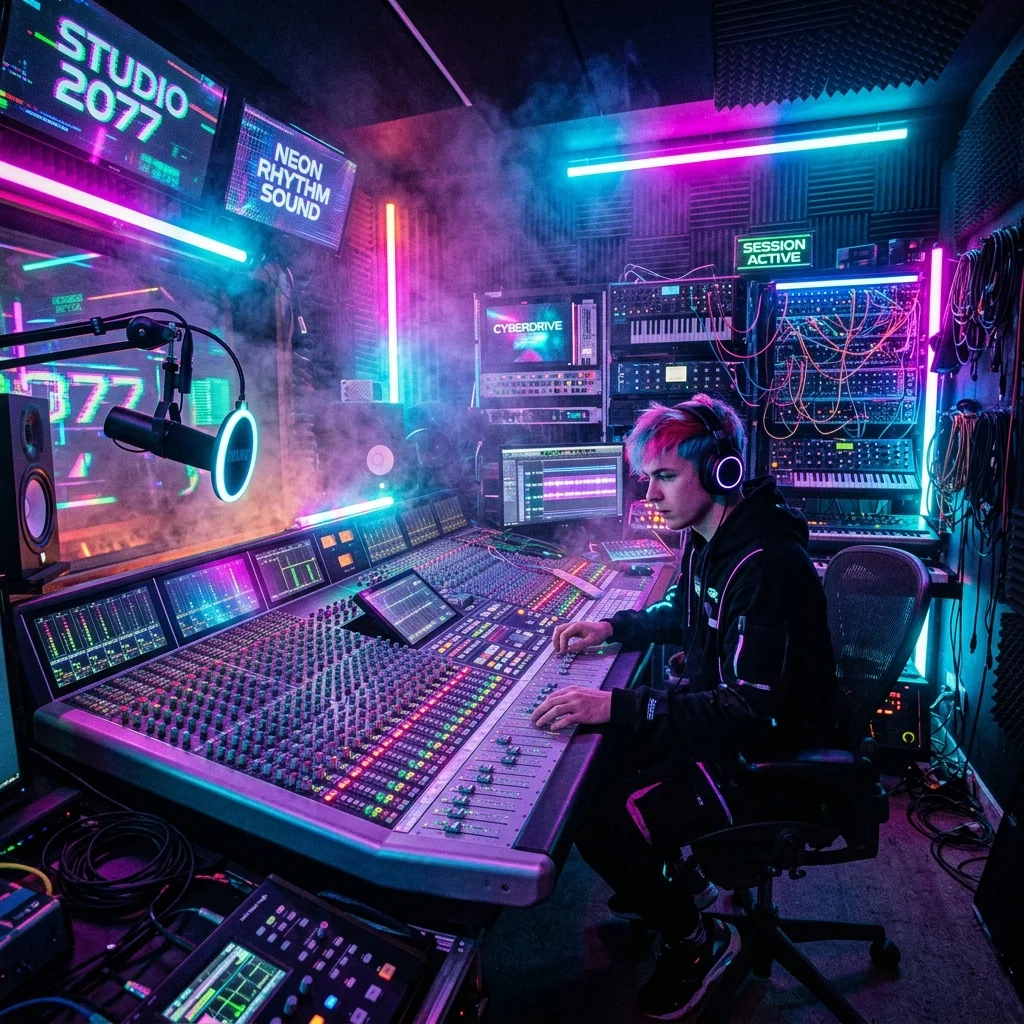

I remember standing in the back of a humid, neon-lit recording studio in San Juan’s Santurce district in early 2026. The producer was hunched over a mixing console, his hands moving rapidly across an Eventide H949 pitch-shifter. He had just recorded a traditional Puerto Rican cuatro melody. Instead of leaving the clean acoustic tone, he pitched it down by a full octave, ran it through a stereo chorus with a 380ms delay, and layered it over a chest-rattling 808 sub-bass. The room vibrated with a woozy, aquatic groove that felt like a hallucinatory dream. Walking through the back alleys of Santurce later that night, the sound bleeding out from the underground warehouse clubs was unmistakably different from the heavy, mechanical reggaeton that defined the last decade. Instead of the relentless, syncopated boom-ch-boom-ch of traditional dembow, the air vibrated with that exact same psychedelic energy.
For the last ten years, Latin urban music has been an unstoppable commercial juggernaut, dominating global streaming charts through the aggressive, booming bass of Latin Trap and the club-ready structures of reggaeton. However, as we move deeper into 2026, a massive sonic shift is actively occurring at the fringes of the genre. A new wave of Latine rappers and producers is fundamentally rewiring the DNA of the movement, dragging global hip-hop into a neon-soaked, hallucinatory territory: Psychedelic Latin Rap.
This isn't just about rapping lazily over Travis Scott or Kid Cudi "type beats." This movement represents a deeply cultural and technical synthesis. It is the careful blending of heavy, atmospheric synthesizers and distorted trap percussion with traditional regional instrumentation—reverberating Spanish guitars, digitally mangled brass sections, and indigenous Andean rhythms. The result is a sonic landscape that feels both entirely futuristic and deeply ancient.
---
The Pioneers of the Neon Sound
The evolution from traditional street-level Latin Trap to psychedelic hip-hop didn't happen overnight. It was born in the margins, driven by experimental producers and artists who were structurally bored with the formulaic requirements of mainstream radio hits. They sought a sound that could match the anxiety, the digital overload, and the escapism of the modern era.
Today's frontrunners are utilizing extreme vocal manipulation, deep phasing effects, and non-linear song structures. Instead of the standard pop format of 16-bar verses followed by a catchy, repetitive chorus, these tracks often play out like cinematic scores or lucid dreams. An acoustic flamenco guitar intro might suddenly shatter into a crushing, distorted trap drop, bathed in heavy reverb that makes the vocalist sound as if they are echoing through a massive, empty cathedral.
Psychedelic Latin Rap is a subgenre of hip-hop characterized by the fusion of traditional Latin American acoustic instruments with ambient synthesizers, non-linear song structures, and heavily manipulated, echo-drenched vocals.
This stylistic shift is heavily influenced by the globalization of internet subcultures. These artists grew up listening to Daddy Yankee, Tego Calderón, and Vico C, but they were simultaneously absorbing the psychedelic indie rock of Tame Impala and the dark, brooding cloud trap of the early SoundCloud era. The resulting fusion is a genre that actively refuses to be categorized.
---
Technical Audio Processing: Modulating Acoustic Textures
To achieve the signature "underwater" sound of Psychedelic Latin Rap, producers rely on specific digital processing configurations for acoustic instruments. For instance, the requinto guitar is run through an Eventide H949 hardware harmonizer or its digital plug-in equivalent. Eventide pitch-shifting is a hardware-emulated digital processing method that allows precise manipulation of audio frequency and formant characteristics to generate surreal harmonic textures.
The engineer will configure a micro-pitch shift setup: the left channel is pitch-shifted up by +9 cents, while the right channel is shifted down by -9 cents. Micro-pitch shifting is an audio engineering technique where the pitch of a signal is duplicated and detuned by a few cents on both sides of the stereo field to create a wider, thicker sound.
This wide signal is then routed through a Roland Juno-106 analog chorus emulator, which introduces a slow, low-frequency oscillation (LFO) modulation to the pitch, creating a warm, organic wobble. Finally, a 1/4 note stereo delay with 45% feedback is added, with the delay return channel side-chained to the lead kick drum to ensure the echoes duck in volume during transient hits, maintaining mix clarity.
---
Instrumentation Deep-Dive: Mangling Tradition
What truly separates Psychedelic Latin Rap from its North American counterparts is the sourcing of its acoustic elements. While American psychedelic rap often samples classic 70s soul or rock records, this new Latine wave looks inward to its cultural heritage, utilizing traditional instruments but processing them through cutting-edge digital effects.
1. The Requinto: A smaller, higher-pitched version of the classical guitar often used in boleros. In psychedelic rap, the requinto is typically run through heavy chorus and delay pedals, creating a swirling, watery sound that contrasts sharply with the aggressive 808 bass underneath it.
2. The Charango: A small Andean stringed instrument traditionally made from the shell of an armadillo. Producers are recording raw charango plucks and time-stretching them digitally until they sound like alien, ambient synthesizers.
3. The Guiro and Congas: Traditional Caribbean percussion instruments that are now being heavily saturated with distortion and distortion plug-ins, turning organic, acoustic slaps into heavy, industrial-sounding impacts.
By taking these deeply traditional, recognizable sounds and morphing them into something entirely alien, producers are creating a sense of musical uncanny valley—a sound that feels simultaneously familiar and completely unknown.
| Artist / Collective | Primary Sub-Genre | Signature Regional Instrument | Key Producer Collaboration | Visual Aesthetic |
| :--- | :--- | :--- | :--- | :--- |
| Los Neo-Santos | Psych-Reggaeton | Pitch-Shifted Requinto Guitar | Tainy & Sky Rompiendo | Cyberpunk San Juan, Neon |
| Aluna | Andean Cloud Trap | Time-Stretched Charango | Bizarrap | Surrealist Landscapes |
| El Fantasma | Industrial Dembow | Distorted Brass & Guiro | Ovy On The Drums | Glitch Art, VHS Horror |
---
The Visual Aesthetic: Cyberpunk Meets Heritage
You cannot discuss this musical evolution without acknowledging the accompanying visual aesthetic. The psychedelic shift has completely transformed the way these artists present themselves to the world.
The high-end designer labels and standard gorpcore streetwear are still present, but they are now filtered through a surreal, almost cyberpunk lens. Music videos associated with this movement rarely feature the traditional tropes of reggaeton videos—there are no yacht parties, standard club scenes, or fleets of luxury sports cars. Instead, they are highly conceptual, featuring heavy CGI, neon color palettes, surrealistic landscapes, and themes of existentialism and altered consciousness.
It is a visual language that speaks perfectly to a generation raised on the internet, offering an escape from reality into a highly stylized, hyper-vibrant digital universe where heritage and technology collide.
!A vibrant, neon-soaked recording studio with colorful LED lights and atmospheric smoke
---
The Industry Impact: Major Labels Scramble
The commercial viability of Psychedelic Latin Rap was initially questioned by major label executives, who believed the tracks were too weird, too long, and too unstructured for mainstream Spotify playlists. However, as with all true cultural shifts, the audience proved the executives wrong.
By mid-2025, independent tracks utilizing this sound began going massively viral on TikTok, not for dance challenges, but as the backing tracks for atmospheric, moody "core" aesthetic videos. Once the streaming numbers began to rival traditional reggaeton hits, the major labels—Universal Music Latin, Sony Music Latin, and Warner Music Latina—began a frantic arms race to sign the underground producers architecting the sound.
A&R (Artists and Repertoire) is the division of a record label responsible for talent scouting and overseeing the artistic development of recording artists and songwriters.
Today, A&R representatives are no longer just looking for the next reggaeton pop star; they are actively seeking producers who know how to blend modular synthesis with acoustic Latin instrumentation. The budgets for music videos and studio time have skyrocketed, pushing the genre from underground warehouse parties to global stadium tours. This structural shift highlights the exact same loss of label gatekeeping authority we examined in our breakdown of why major record labels are becoming obsolete.
---
The Global Crossover Appeal
Why is this specific, highly atmospheric sound dominating the global conversation in 2026?
The answer lies in the universal language of vibration and atmosphere. Traditional lyric-heavy hip-hop often struggles to cross language barriers fully; if you don't speak the language fluently, you lose the intricacies of the wordplay, the double entendres, and the narrative flow.
However, psychedelic music is inherently visceral. You don't need to speak fluent Spanish to feel the immense emotional weight of a heavily distorted, echoing vocal cascading over a massive, cinematic synthesizer pad. This sonic architecture acts as an emotional bridge. It allows English-speaking hip-hop fans—who are already conditioned to the atmospheric sounds of modern US rap—to instantly connect with the emotional resonance of the track without needing a translation app.
It is breaking down the final barriers between the massive Latin American market and the global hip-hop consciousness, proving that the future of the genre is borderless, genre-fluid, and undeniably psychedelic.
---