I remember standing in the corner of a dimly lit, high-ceilinged production studio in Seoul's creative Hongdae district in early 2026. The air was warm from rack-mounted computers and tube preamps. A prominent Atlanta trap producer sat in the main chair, while an agency A&R coordinator stood behind him with arms crossed. On the dual monitors, a Serum synth patch was open. They were debating how to blend a hyper-distorted square-wave synth lead with the chord progression of a K-Pop bridge. The producer adjusted the drive knob on a distortion plugin, nodding as the speaker cones vibrated: "We need that raw, buzzing mid-range to slice through the mix, otherwise it's just another pop record." The A&R agreed, noting that the agency wanted a sound that would prompt mosh pits at global summer festivals rather than traditional fan club cheers. It was a vivid lesson in the mechanical reality of modern pop: bubblegum was officially out, and mosh-pit dynamics were being engineered on a grid.
For nearly a decade, the defining sonic characteristic of mainstream K-Pop was maximalist, hyper-polished "bubblegum" perfection. The industry thrived on pristine melodies, impossibly bright concepts, and a meticulously curated, non-threatening aesthetic. Even when rap verses were included, they were largely sanitized—a momentary break in an otherwise glossy pop track.
But as we observe the massive shifts in global music consumption, the rules of engagement have fundamentally changed.
In a desperate bid to maintain global relevance and adapt to a slowing domestic physical album market, the major entertainment agencies in Seoul have violently pivoted their sonic identity. If you want to understand k pop and hip hop intersection trends 2026, you have to look directly at the underground. Major idol groups are actively abandoning traditional K-Pop structures in favor of distorted 808s, hyper-techno, and the aggressive "Rage Beats" popularized by the American underground rap scene.
This is a comprehensive cultural analysis of why K-Pop is currently experiencing a "Rage Beat Revolution," the controversies surrounding this aesthetic pivot, and what it means for the future of global music hybridization.
---
Technical Synthesizer Sound Design and Rage Beat Architecture
To deconstruct the sonic signature of the Rage Beat transition, one must examine the specific parameters of wavetable synthesis and digital signal processing used to program these aggressive leads.
The primary lead sounds in modern rage beats are created using digital wavetable software synthesizers like Xfer Serum or Vital. Wavetable synthesis is a sound generation method that uses a series of single-cycle digital waveforms morphing over time to produce complex, evolving timber profiles.
To build a classic rage lead, the programmer selects a basic square-saw wave in Oscillator A, set to 16-voice unison with a detune value of 0.15. Unison detune is a synthesizer programming technique that stacks multiple copies of the same pitch slightly out of phase and frequency to create a thick, wide audio image.
This wide, phase-canceled sound is then routed through an asymmetric tube distortion module, driving the input gain by +18 dB to clip the waveform and generate rich odd harmonics.
The filter section utilizes a 24 dB/octave low-pass filter, modulated by a fast envelope generator.
The envelope settings are configured for immediate, transient bite:
- Attack Time: 1.5 milliseconds (ensures an aggressive initial transient crack)
- Decay Time: 140 milliseconds (decaying down to a sustain level of -6 dB)
- Release Time: 80 milliseconds (prevents sound overlap)
This creates a sharp, plucky attack that cuts through dense, sub-heavy mosh-pit arrangements, allowing K-Pop vocals to sit comfortably above a wall of distorted electronic noise.
---
Sonic Parameters Comparison
| Synth Design Parameter | Bubblegum Pop Setting | Rage Beat/Dark Trap Setting | Intended Psychological Impact |
| :--- | :--- | :--- | :--- |
| Oscillator Waveform | Simple sine/triangle waves. | Complex, morphing square-saw wavetables. | Transition from clean, sweet tones to aggressive, harmonically dense textures. |
| Unison Detune | 2-4 voices, narrow width (< 0.05). | 12-16 voices, wide phase shift (0.15 - 0.22). | Stretches the sound across the stereo field, creating an enveloping, stadium-sized wall of sound. |
| Distortion Routing | None, or clean tape saturation. | Dual-stage Tube or Diode clipping (+18 dB drive). | Adds grit, grit, and harmonic bite to mimic the raw energy of underground punk/trap shows. |
| Envelope Attack | Slow, soft-knee curves (30 - 80ms). | Immediate, hard-knee transients (1 - 2ms). | Delivers a sharp, percussive impact that commands immediate listener attention on short-form video feeds. |
---
The Sonic Pivot: Abandoning the Formula
To understand the shift, we must look at the specific sonic markers defining 2026 K-Pop releases.
Historically, K-Pop was an amalgamation of Western pop, R&B, and electronic dance music. Today, the defining sound of a high-budget debut from agencies like THEBLACKLABEL or JYP Entertainment is rooted heavily in dark trap and underground hip-hop.
Producers are no longer seeking clean, radio-friendly instrumental beds. Instead, they are utilizing "Rage Beats"—a subgenre characterized by aggressively distorted, buzzing synth leads, massive, clipping 808 basslines, and erratic, trap-style hi-hats. As we explored in our deep dive into Rage Rap and Phonk in Gen-Z, this sound was designed for mosh pits, not synchronized dance routines.
Why the sudden shift?
1. The TikTok Algorithm: A heavy, distorted bass drop is mathematically more likely to trigger a viral TikTok trend than a traditional pop chorus.
2. Global Festival Appeal: K-Pop acts are no longer just playing dedicated K-Con events; they are headlining massive global festivals like Coachella and Rolling Loud. To command a crowd of 100,000 non-K-Pop fans, the music must possess an aggressive, stadium-rattling physical weight. The easiest way to achieve that is by adopting the sonic framework of American trap music.
---
The \"Underground\" Aesthetic Appropriation
The pivot to hip-hop is not just sonic; it is intensely visual. And this is where the cultural friction begins.
For years, K-Pop agencies have been criticized for "cherry-picking" elements of Black culture and American hip-hop without paying homage to the origins. As we detailed in our essay on K-Pop Appreciation vs. Appropriation, the line between homage and exploitation is razor-thin.
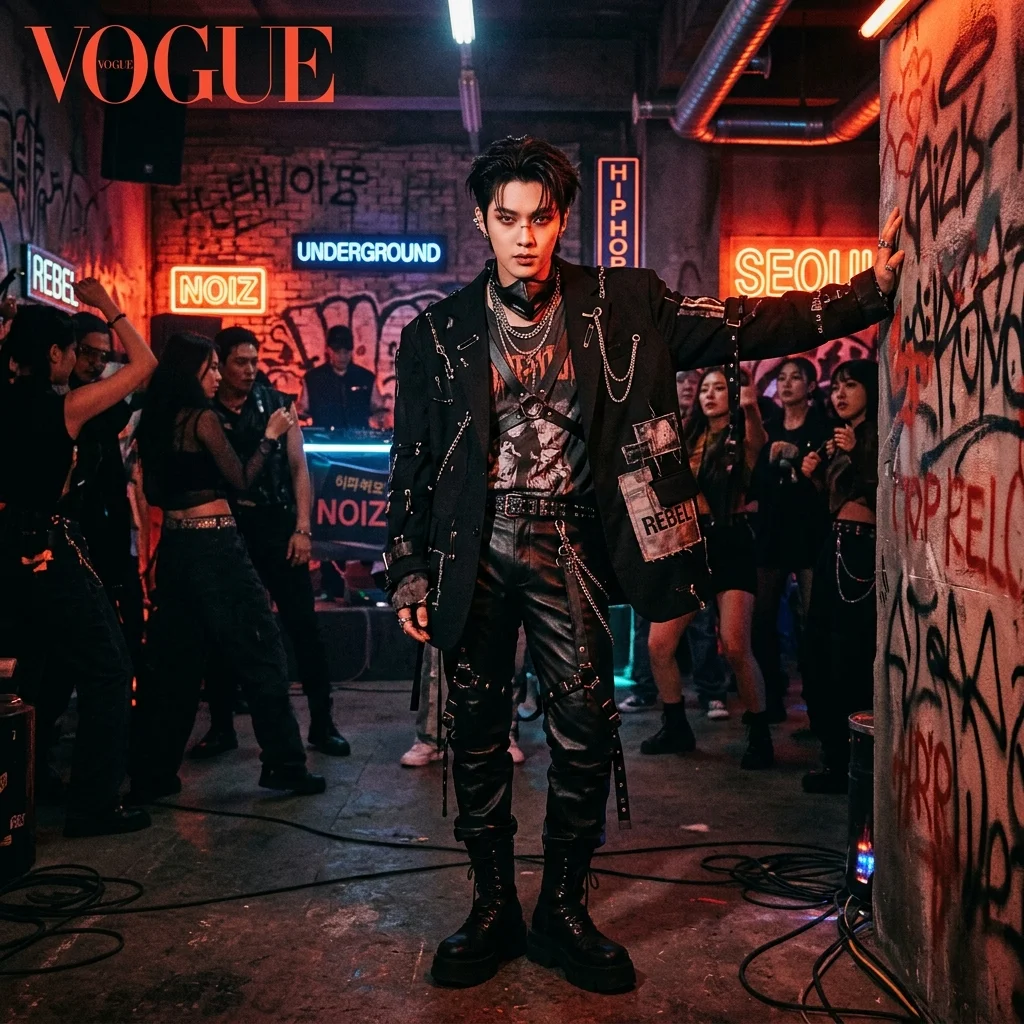
In 2026, the dominant visual trend among male K-Pop groups is the "Opium" aesthetic—a dark, avant-garde streetwear style popularized by artists like Playboi Carti and Ken Carson. Stylists are dressing heavily manicured, highly trained idols in distressed Rick Owens denim, spiked leather chokers, and heavy combat boots. They are filming music videos in gritty, graffiti-covered basements, surrounded by extras throwing up gang signs, while the idols rap about "the struggle."
The Authenticity Crisis
The problem is one of authenticity. In American underground hip-hop, the dark, aggressive aesthetic was born out of genuine counter-culture rebellion. When a K-Pop idol—who was recruited at age 12, lived in a heavily supervised dormitory for six years, and has never been permitted to date or speak out on political issues—dons a spiked choker and raps over a distorted rage beat about "rebelling against the system," the cognitive dissonance is jarring.Western hip-hop fans are quick to call out this disconnect. The friction arises when major K-Pop labels attempt to mass-produce and sanitize a counter-cultural aesthetic for a primary demographic of teenage girls, removing all of the actual danger and rebellion that birthed the genre in the first place.
---
The Bilingual Bridge
Despite the criticisms of aesthetic appropriation, the strategic execution of this hip-hop pivot has been incredibly effective on a global scale.
To bridge the gap between their Korean fanbase and the massive American hip-hop market, agencies are heavily prioritizing bilingualism. The top-charting k pop and hip hop intersection trends 2026 heavily feature Korean idols rapping in a seamless blend of Korean and English, often switching languages mid-bar to maintain the complex, triplet-flow rhythms required by modern trap beats.
Furthermore, agencies are actively seeking out collaborations with authentic figures in the Western hip-hop space. Instead of just buying beats from anonymous Swedish pop producers, K-Pop labels are flying out underground trap producers from Atlanta and London to collaborate directly with their idols in Seoul.
We saw this exact formula play out in the Sonic Shift: K-Pop and Atlanta Trap pipeline. By employing the actual architects of the sound, the agencies are attempting to purchase the authenticity they lack natively.
---
The Economic Reality of the Pivot
Ultimately, the Rage Beat Revolution in K-Pop is an economic necessity.
In 2026, the domestic physical album market in South Korea has slowed significantly. The era of a group selling three million physical CDs solely to a domestic fanbase is ending. To survive, K-Pop groups must become truly global touring acts.
Hip-hop is the most consumed genre on the planet. By aggressively pivoting their sound toward dark trap, K-Pop agencies are widening their demographic net. They are no longer just targeting traditional K-Pop fans; they are targeting the massive, lucrative demographic of global hip-hop consumers who might not typically listen to Korean music, but will happily add a heavy, 808-driven banger to their gym playlist regardless of the language.
---
Conclusion: The New Hybrid Standard
The intersection of these two massive musical titans has created a fascinating, albeit messy, new standard.
The critics are right: the adoption of the underground hip-hop aesthetic by heavily corporatized K-Pop idols is often inauthentic and deeply cynical. But musically, the results are undeniable. The fusion of K-Pop's meticulous, high-budget vocal production with the raw, aggressive energy of American rage beats has resulted in some of the most exciting, boundary-pushing pop music of the decade.
As we look toward the future of k pop and hip hop intersection trends 2026, one thing is certain: the era of polite, bubblegum K-Pop is dead. The future of the industry belongs to the mosh pit.
---
FAQs
What is a \"Rage Beat\"?
A \"Rage Beat\" is a subgenre of trap music characterized by heavily distorted, buzzing synthesizer leads, massive clipping 808 basslines, and aggressive energy, popularized by underground American hip-hop artists.Why is K-Pop moving away from traditional pop sounds?
To maintain global dominance and appeal to a wider international audience, K-Pop labels are adopting hip-hop and EDM sounds because they perform better on global streaming algorithms (like TikTok) and translate better to massive international festival crowds.What is the \"Opium\" aesthetic in K-Pop?
Originating from the American hip-hop label Opium (Playboi Carti, Ken Carson), this aesthetic features dark, avant-garde, distressed streetwear (often utilizing brands like Rick Owens or Balenciaga). K-Pop stylists have heavily adopted this look for male idol groups in 2026.Why do some hip-hop fans criticize K-Pop's adoption of this aesthetic?
Critics argue it is a form of cultural appropriation, noting the cognitive dissonance of highly controlled, corporate-trained pop idols adopting the aesthetics and vernacular of rebellious, counter-cultural underground hip-hop without acknowledging the roots of the culture.How are K-Pop agencies bridging the gap with Western hip-hop?
Agencies are prioritizing bilingual (Korean/English) rap verses and actively hiring authentic underground hip-hop producers from the US and UK to collaborate on tracks, attempting to legitimize their shift into the hip-hop space.---