Every single week, without fail, on Twitter, Reddit, in YouTube comment sections, and in barbershops across the country, the exact same exhausted, deeply unoriginal argument plays out.
An "old head" will aggressively post a chaotic, high-energy clip of a modern artist like Yeat or Playboi Carti performing at a massive music festival, accompanied by a condescending caption like, "Hip-Hop is officially dead. Imagine playing this garbage for 2Pac." In immediate, furious response, a younger teenage fan will deliberately post a clip of a highly revered 90s boom-bap rapper and dismissively call it "boring, dusty backpack music."
As the Senior Cultural Critic for ThugNews, I am officially, publicly begging the global hip-hop community to stop having this completely useless argument. It is a fundamentally flawed, artistically bankrupt comparison.
We need to collectively understand an absolute, undeniable truth about the music industry in 2026: Modern hip-hop is not a direct continuation of 90s hip-hop. It is a completely different, heavily mutated genre operating under entirely different cultural and sonic rules. Judging a 2026 synthesized rage-rap anthem by strict 1994 New York lyrical standards is as intellectually ignorant as judging a heavy metal song by how smoothly you can waltz to it.
The Paradigm Shift: From Lyrics to Vibe
The core foundation of the relentless "Golden Era" argument always, inevitably centers around the concept of traditional lyricism. The 1990s were undeniably the historical apex of intricate, multi-syllabic rhyme schemes, profound street storytelling, and dense, double-entendre wordplay. Legendary artists like Nas, The Notorious B.I.G., the Wu-Tang Clan, and a young Jay-Z treated the stripped-down instrumental beat as a stark, blank canvas; the words were the vibrant paint. If the lyrics were weak, the song fundamentally failed.
The Evolution of Lyrical Density
To understand the modern disconnect, we must examine the concept of "lyrical density." In 1994, a classic track like Nas's "N.Y. State of Mind" featured an incredibly dense lyrical structure, packing hundreds of complex, heavily narrated words into a single, breathless verse. The goal was intellectual and narrative dominance.
In 2026, the overall paradigm has completely flipped. For the vast majority of modern, youth-driven hip-hop, traditional, narrative lyrics are secondary. The human voice itself is actively used as an instrument, heavily processed, pitch-shifted, and mixed deep into the beat directly alongside the distorted 808s and the blaring synths.
When you listen to a modern "rage" or "plugg" track from an artist like Ken Carson, you are absolutely not supposed to be dissecting the complex metaphors in the second verse. You are supposed to be absorbing the visceral, chaotic, physical energy of the distorted bass, the rapid-fire hi-hats, and the melodic, autotune-drenched vocal inflections.
It is, by definition, impressionistic music. It is entirely about conveying a raw, unadulterated emotion or a specific "vibe" rather than delivering a literal, spoken-word narrative. Complaining that a Playboi Carti song lacks lyrical depth is like complaining that a Jackson Pollock painting lacks a clear storyline. You are entirely missing the point of the art.
The Billboard Reality: 1996 vs 2026
To truly understand how completely the genre has shifted away from traditional lyrical density toward melodic vibes, we only have to look at the historical data. Let's compare the defining mainstream sounds of both eras.
| Historical Era | Top 5 Billboard Rap Singles | Primary Sonic Characteristics | Lyrical Focus |
| :--- | :--- | :--- | :--- |
| 1996 (Golden Era) | 1. "Tha Crossroads" (Bone Thugs)
2. "California Love" (2Pac)
3. "Gangsta's Paradise" (Coolio)
4. "Elevators" (Outkast)
5. "Keep Ya Head Up" (2Pac) | Sample-heavy boom-bap, live instrumentation, prominent basslines. | Narrative storytelling, social commentary, complex rhyme schemes. |
| 2026 (Modern Era) | 1. "VAMP ANTHEM pt 2" (Carti)
2. "LÜV DRUG" (Yeat)
3. "TOKYO DRIFT" (Ken Carson)
4. "GLO" (Chief Keef)
5. "DIAMONDS" (Lil Uzi Vert) | Extremely heavy 808 distortion, synthetic melodies, high BPM. | Repetitive hooks, melodic vocal inflections, atmospheric "vibe". |
Note: The 2026 tracks are representative examples of the dominant Billboard sound.
You simply cannot judge a highly impressionistic, energy-driven painting by angrily asking why it doesn't look like a hyper-realistic photograph. They have fundamentally different artistic goals and cater to different human emotions.
The Evolution of the "Beat"
The other major, often ignored factor heavily contributing to this generational divide is the rapid, explosive evolution of music production technology.
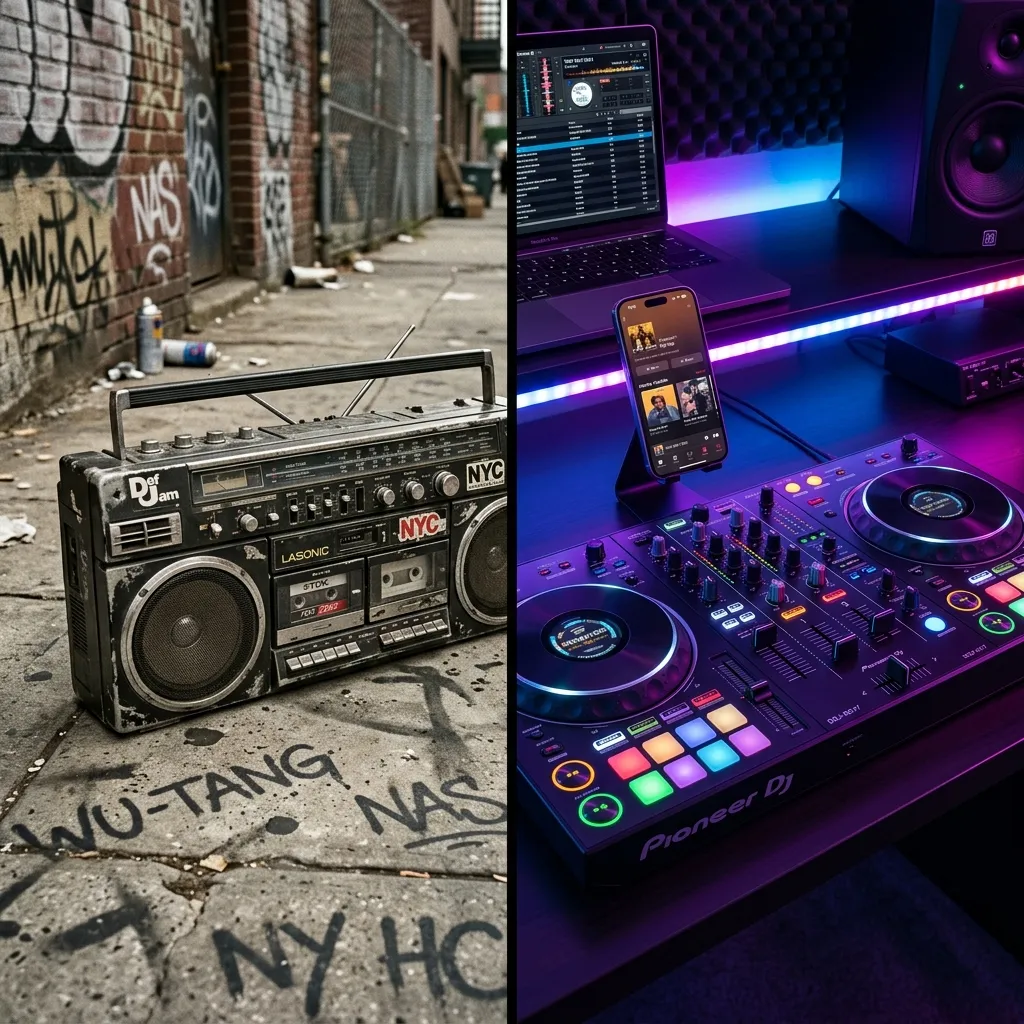
In the 90s, producers were severely limited by their physical hardware (MPC60s, SP-1200s). The beats were inherently simpler because of extremely limited, expensive sample time. This forced simplicity left massive, open sonic spaces in the mix that explicitly required a highly skilled, dynamic lyricist to fill them up.
Today, a 16-year-old independent producer sitting in their bedroom can create a digital instrumental so sonically dense, musically complex, and overwhelming that adding complex, wordy lyrics directly on top of it would actually ruin the mix and clutter the track. The beat is the absolute star. The rapper is simply providing the melodic icing on top of an incredibly complex, layered production cake.
The Hypocrisy of the "Golden Era" Purist
The most deeply frustrating aspect of this endless debate is the blatant, shameless historical revisionism of the older generation.
The angry purists who constantly claim that "all 90s hip-hop was conscious and deeply lyrical" are flat-out lying to themselves. The 90s had plenty of mindless party tracks, incredibly simple club anthems, and purely vibe-based dance music (think Sir Mix-a-Lot or MC Hammer).
Furthermore, the revered pioneers of the Golden Era faced the exact same condescending criticism from the generation immediately before them. In the late 80s, older R&B and jazz musicians dismissed the emerging hip-hop genre entirely, calling it "unmusical noise" and complaining bitterly that "they aren't even playing real instruments, they are just stealing other people's records."
Every single generation selfishly believes that the music of their youth was the absolute, undeniable creative peak of human history, and that the music of the subsequent generation is a disrespectful, talentless degradation of the art form. It is not an objective musical critique; it is simply the natural, unavoidable cycle of human aging.
The Coexistence of Sub-Genres
The single most beautiful thing about global hip-hop in 2026 is its massive, unprecedented sheer size. The genre has safely splintered into dozens of highly thriving, independent micro-genres.
If you want intricate, 90s-style lyricism and dusty boom-bap beats, it absolutely still exists in massive quantities! Artists like Griselda, J. Cole, Kendrick Lamar, JID, and countless underground MCs are producing incredible, lyrical masterpieces every single year. You don't have to listen to the new autotune rage-rap if you don't want to.
But you also don't have to violently disrespect the youth culture that loves it. Let the kids rage, and let the old heads listen to Illmatic in peace.
---
Frequently Asked Questions (FAQ)
Was 90s hip-hop actually better than modern rap?
"Better" is entirely subjective. 90s hip-hop was objectively superior in terms of traditional, complex lyricism, multi-syllabic rhyme schemes, and direct street-level storytelling. However, modern 2026 hip-hop is arguably superior in terms of complex vocal melodies, incredibly advanced production techniques, and raw, visceral energy. They excel at completely different things.What exactly is the "Golden Age" of hip-hop?
The "Golden Age" (or Golden Era) of hip-hop typically refers to the period between the late 1980s and the mid-1990s (roughly 1988–1996). It is highly revered for its massive explosion of diverse styles, the heavy use of jazz and soul sampling, and the mainstream rise of complex, highly technical lyricism in both New York and Los Angeles.Is lyricism completely dead in modern hip-hop?
Absolutely not. Artists like Kendrick Lamar, JID, Denzel Curry, and the entire Griselda camp are constantly proving that highly complex lyricism is still incredibly viable and commercially successful. It is simply no longer the only acceptable or dominant way to make a hit hip-hop record.Why do modern rappers use so much autotune?
Autotune is no longer used simply to correct off-pitch singing (as it was originally intended in the early 2000s). In 2026, it is used as a deliberate, heavy stylistic effect, similar to how a rock guitarist uses a heavy distortion pedal. It alters the timbre of the human voice and allows the rapper to blend seamlessly into the highly synthesized melodies of modern trap beats.What is "Rage" rap?
"Rage" is an aggressive subgenre of trap music that became massively popular in the early 2020s. It is characterized by highly distorted, synthetic, video-game-like synth melodies, aggressive blown-out 808 basslines, and high-energy, highly repetitive vocal performances. It was heavily pioneered and popularized by artists like Playboi Carti and Yeat.---
Related Reading & Context
If you are a fan of the Golden Era and want to understand how the legendary producers of that time actually crafted those iconic beats using hardware samplers, read our deep dive on Beat-Making in 2026: DAWs vs Hardware to see how the technology has changed, or explore how modern production works in our Top 10 Best DAWs for Hip-Hop Guide.