In the rapidly evolving landscape of South Korean entertainment, the line between human artistry and technological simulation has not just blurred; it has been entirely rewritten.
As we navigate the back half of 2026, k pop ai virtual idols 2026 represent the most lucrative, yet violently polarizing, segment of the global music industry. The “Enter-Tech” revolution—spearheaded by conglomerates like HYBE, SM Entertainment, and Kakao—has moved beyond simple holographic gimmicks. We are now dealing with fully realized digital entities capable of selling over a million physical albums, dominating the Billboard charts, and headlining real-world stadium tours.
However, beneath the glittering digital surface, a massive ideological war is raging within the fandoms. The industry is currently fractured into two distinct camps: the “Hybrid Enthusiasts” who support motion-capture virtual groups, and the “Human Purists” who view fully generative AI idols as the bleak, late-stage capitalist endgame of the K-Pop machine.
This is a comprehensive analysis of how the AI idol experiment succeeded, why it is failing in specific sectors, and what the newly implemented South Korean AI Basic Act means for the future of your favorite groups.
The PLAVE Paradigm: Why Hybrid Works
To understand the current state of k pop ai virtual idols 2026, one must first understand the gold standard: PLAVE.
Debuting in 2023 and reaching global superstardom by 2025, PLAVE is technically a virtual boy group. Their visual representation consists of highly stylized, anime-esque 3D models. However, the critical distinction that allowed them to bypass the “uncanny valley” and achieve massive mainstream acceptance is that they are not generative AI.
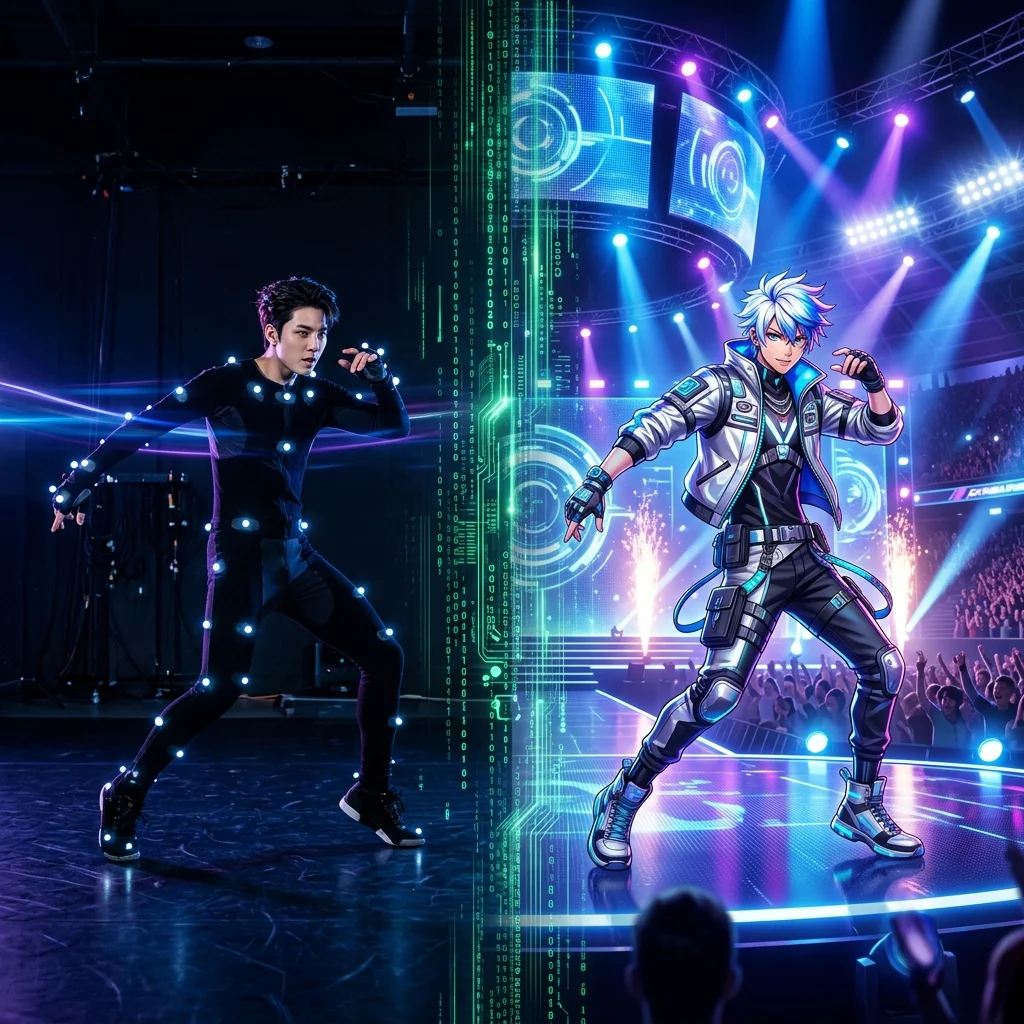
PLAVE operates on a hybrid model. Behind the pristine digital avatars are five real human men wearing advanced motion-capture suits in a studio. These hidden performers write the music, choreograph the dances, sing live, and, most importantly, interact with fans in real-time during live streams.
The Evolution of the VTuber
In our analysis of the K-Pop Fan to Consumer Pipeline, we established that the primary commodity being sold in K-Pop is not the music itself, but the “parasocial relationship.” Fans need to believe they are connecting with a human soul.
PLAVE succeeded because they simply applied high-end K-Pop aesthetics and major-label production budgets to the pre-existing, highly successful “VTuber” (Virtual YouTuber) model. When a PLAVE member messes up a dance move during a live stream and laughs, the physics engine glitches slightly, but the human error is authentic. Fans know there is a real person sweating in a mocap suit. This allows the audience to project emotional attachment onto the avatar without feeling manipulated by a machine.
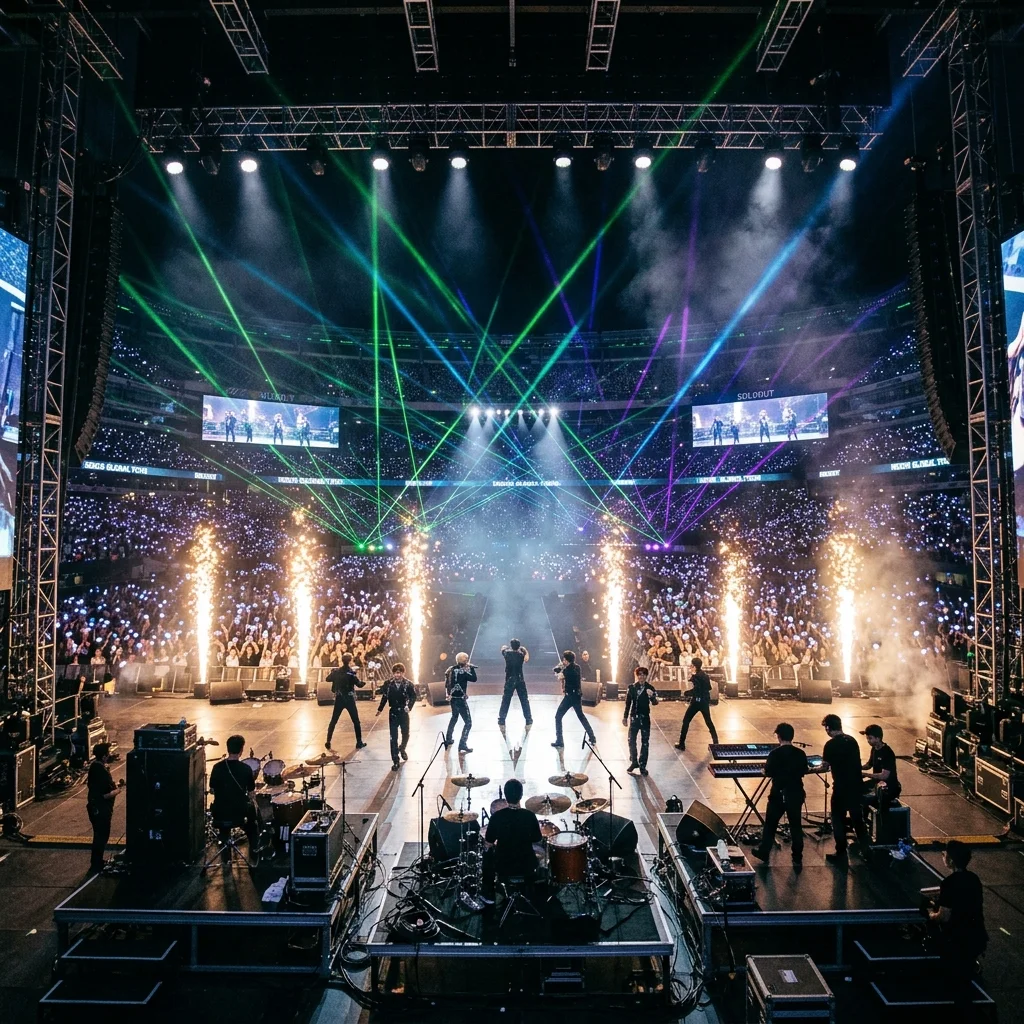
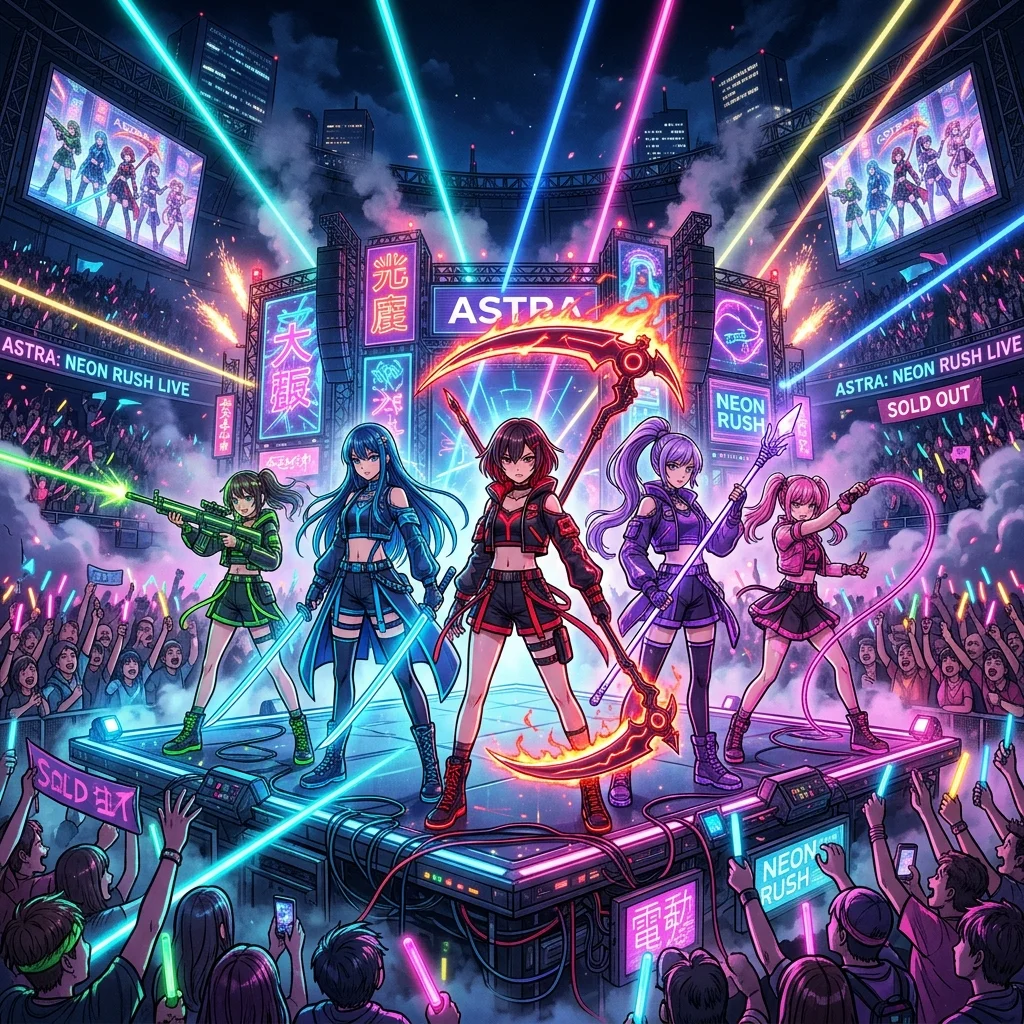
By mid-2026, PLAVE’s success metric is staggering. They routinely sell out massive physical venues (where fans watch their digital avatars broadcast on colossal LED monoliths) and move physical merchandise at a volume that rivals legacy human acts like SEVENTEEN or Stray Kids.
The Generative Backlash: Synthesizing the Soul
While the hybrid mocap model proved successful, the major labels—always seeking to maximize profit margins while minimizing human liability—pushed the envelope further. The true friction regarding k pop ai virtual idols 2026 stems from the introduction of fully generative AI groups.
Agencies like SM Entertainment (with their naevis project) and HYBE (with SYNDI8) began experimenting heavily with entities that did not just use digital avatars, but utilized AI-generated vocal synthesis, algorithmically generated choreography, and LLM-driven (Large Language Model) conversational tools to interact with fans on platforms like Weverse.
The industry logic was ruthless and economically sound:
- Zero Scandals: A generative AI idol cannot get caught in a dating scandal, get a DUI, or demand a contract renegotiation.
- Infinite Stamina: An AI group can conceptually “perform” in Tokyo, New York, and London simultaneously without experiencing physical burnout.
- Complete IP Ownership: The label owns 100% of the intellectual property. They do not have to split touring revenue with a human performer.
The Fandom Revolt
Despite the economic incentives for the labels, the fan response to fully generative AI idols in 2026 has been fiercely hostile.
K-Pop fans are arguably the most organized and vocal consumer demographic on the planet. When labels began pushing music generated by platforms like Suno, performed by voices synthesized from massive data sets, the backlash was immediate. Protest trucks (a staple of K-Pop fan dissatisfaction) lined the streets outside HYBE’s headquarters in Yongsan, demanding the cessation of “soulless, corporate-generated” music.
The core of the revolt lies in the perceived exploitation of the trainee system. The grueling, years-long training process that human idols endure creates a narrative of struggle and triumph that fans invest heavily in. As we noted in our piece on the End of the 360 Deal, authenticity is the ultimate currency. An algorithm cannot struggle. Therefore, an algorithm cannot earn the emotional devotion required to sustain a K-Pop fandom.
The 2026 AI Basic Act: Regulating the Virtual Space
The escalating tension between tech-hungry labels and purist fans culminated in government intervention. In early 2026, the South Korean government passed the AI Basic Act, fundamentally altering how “Enter-Tech” companies operate.
The most critical mandate for the entertainment sector was the Mandatory Labeling Requirement.
Any music, video, or promotional image utilizing generative AI must now carry a distinct, visible watermark (both visually and embedded in the metadata). Furthermore, agencies are legally required to disclose the exact percentage of human involvement versus AI generation in a given project.
This transparency law effectively killed the illusion. When fans could explicitly see that a new virtual girl group’s debut single was “85% Algorithmically Generated,” the projects lost all cultural traction. The AI Basic Act forced the major labels to retreat from fully generative audio models and pivot back toward the “PLAVE” hybrid model—using AI strictly for visual rendering and real-time translation, while maintaining human vocalists and dancers at the core.
The Future: Augmented Reality and the Meta-Concert
If fully generative idols have stalled, what is the future of k pop ai virtual idols 2026?
The industry is currently pivoting hard toward Augmented Reality (AR) and localized “Meta-Concerts.” Rather than trying to replace human idols entirely, agencies are using AI to create impossible, highly lucrative live experiences.
Imagine attending a concert for a human K-Pop group like Aespa or NewJeans. In 2026, premium VIP ticket holders are given lightweight AR glasses upon entry. While the human members perform physically on the main stage, their virtual, AI-enhanced avatars perform simultaneously in the air above the crowd, interacting with the physical pyrotechnics and laser design.
This is the compromise the industry has settled on. They are utilizing the massive advancements in real-time rendering and spatial computing to enhance the human performance, rather than replace it. This satisfies the fans’ demand for authentic human connection while allowing the labels to monetize high-end technology.
Conclusion: The Persistence of Human Imperfection
The great k pop ai virtual idols 2026 experiment has ultimately proven one comforting truth about the music industry: perfection is boring.
An AI can be programmed to hit every high note perfectly, execute every dance move with mathematical precision, and respond to fan messages with flawlessly calculated charm. But K-Pop, at its core, is a deeply human drama. Fans love the voice cracks during a demanding high note. They love the exhaustion on an idol’s face at the end of a three-hour set. They love the unscripted, chaotic banter between group members during a live stream.
Technology will continue to shape how we consume K-Pop, and hybrid virtual idols like PLAVE have earned their permanent place in the ecosystem. But the failure of fully generative AI groups to capture the global zeitgeist proves that in an increasingly sterile, automated world, consumers are desperate for the messy, unpredictable reality of human art.
FAQs
What is the difference between PLAVE and an AI Idol?
PLAVE is a “hybrid” virtual group; the visual avatars are digital, but the singing, dancing, and interactions are performed live in a studio by real human men wearing motion-capture suits. True generative AI idols rely on synthesized voices and algorithmic choreography without direct human performance.
Why are K-Pop labels investing in virtual idols?
Virtual idols offer immense economic benefits to labels: they never age, they do not require physical rest, they cannot be involved in personal scandals (dating, DUIs), and the agency retains 100% ownership of the intellectual property without having to split touring revenue with human performers.
What is the South Korean AI Basic Act of 2026?
The AI Basic Act is a regulatory framework that, among other things, requires entertainment agencies to clearly label any content (music, video, images) created using generative AI, preventing companies from secretly replacing human artists with algorithms.
Will AI completely replace human K-Pop idols?
Industry consensus in 2026 suggests no. While virtual avatars and AR enhancements are becoming standard, fans have fiercely rejected fully generative (soulless) AI music, proving that the parasocial connection to a real human remains the core driver of the K-Pop economy.
How do virtual idol concerts work in real life?
Currently, virtual idols “perform” via massive, high-definition LED screens or holographic projections in physical stadiums, often accompanied by live human backup dancers and a live band to create a traditional concert atmosphere.
Keep Reading
If you’re fascinated by the intersection of technology and music, read our analysis on the Future of Hip-Hop AI. To understand the economic models driving these agency decisions, check out our deep dive into the K-Pop Economic Blueprint.