I remember sitting in a sun-drenched conference room on Sunset Boulevard in West Hollywood in the spring of 2025. On the polished glass table sat a draft contract from a major label group, proposing a $1.2 million advance. Next to me, a nineteen-year-old viral rapper and his manager were doing math on a tablet. Instead of looking impressed by the numbers, the manager politely slid the contract back across the table. They had calculated that with the rapper's current monthly streaming audience, a standard 360 deal would recoup so slowly that the artist would essentially be working for free for the next five years. They chose instead to walk away and sign a flat 15% distribution fee deal. It was a clear demonstration of how the power balance in the music industry has shifted.
The traditional music industry is currently undergoing a massive structural re-evaluation. The "360 deal," which was the backbone of major label profitability for the last two decades, is increasingly being viewed by emerging artists not as an opportunity, but as a predatory tax on their labor.
Instead, a new generation of artists is leveraging powerful independent distribution platforms to build autonomous, highly profitable businesses. In 2026, the modern independent artist views the major record label not as an all-powerful gatekeeper, but simply as a high-interest venture capital firm—one whose money they often no longer need.
---
The Economics of Streaming and Royalty splits
To evaluate why independent distribution has become so appealing, one must analyze the raw math behind streaming payouts and contract royalty structures.
On average, Spotify pays out approximately $0.003 to $0.004 per stream (often averaging around $0.00318) to the master owner/distributor. Under a traditional major label contract, the artist’s royalty share is typically 15% to 20% of net receipts.
If an artist’s song generates 10,000,000 streams:
- The gross master payout is roughly $31,800.
- Under a traditional 15% major label deal, the artist’s account is credited with just $4,770 (which is first applied to recoup their advance, recording budgets, and 50% of video costs). The label pockets the remaining $27,030.
- In contrast, under an independent distribution deal with a 15% admin fee (such as a label services deal), the artist retains 85% of the gross master payout, taking home $27,030 directly, with the distributor receiving $4,770.
```
Gross Royalty Generation (10M Streams = $31,800):
Major Label Contract (15% Artist Share):
Artist Recoupment Pot: [ $4,770 ] ---> applied to debts first
Label Share: [ $27,030 ] ---> kept by label
Independent Distribution (15% Fee Deal):
Artist Payout: [ $27,030 ] ---> paid directly to artist
Distributor Share: [ $4,770 ] ---> kept by distributor
```
Furthermore, artists must navigate the collection of mechanical royalties. Mechanical royalties are fees paid to songwriters and publishers for the right to reproduce and distribute copyrighted musical compositions on physical formats and digital streaming services.
In the United States, mechanical royalties are collected and distributed by the Mechanical Licensing Collective (MLC) under rates set by the Copyright Royalty Board (CRB), which for streaming scales up to 15.35% of a service's service revenue. Under a standard major label deal, these publishing assets are frequently cross-collateralized against outstanding master recording debts. Cross-collateralization is a contractual mechanism that aggregates debts across multiple albums or revenue streams, preventing an artist from receiving royalties until all combined accounts are fully recouped.
By maintaining independent distribution, artists can prevent their publishing and mechanical royalty streams from being tied to their master recording advances.
---
The Reality of the 360 Deal
To understand why artists are fleeing the traditional label structure, we must understand the mechanics of the multiple-rights contract. A 360 deal is a contractual agreement where a record label provides financial advances and marketing support in exchange for a percentage of the artist's total career revenue—including touring, merchandise, brand endorsements, and publishing—in addition to recorded music sales.
Labels historically justified these deals by arguing that because they invest massive amounts of capital to "break" an artist, they are entitled to a share of the resulting income across all streams. If the label pays to put your music video on television, they argue they should get a cut of the t-shirt you sell at your concert.
The Financial Architecture: Major Label vs. Independent (2026)
| Deal Structure | Master Ownership | Revenue Split (Artist/Label) | Income Streams Claimed | Best Suited For |
| :--- | :--- | :--- | :--- | :--- |
| Traditional 360 Deal | Label owns Masters | 15% - 20% to Artist | Streaming, Touring, Merch, Publishing | Global Pop Superstars, Manufactured Acts |
| Label Services Deal | Artist owns Masters | 50% - 80% to Artist | Streaming (Distribution only) | Established artists needing marketing capital |
| Independent Distro | Artist owns Masters | 100% to Artist (minus flat fee) | None (Artist keeps 100% of all streams) | Independent entrepreneurs, Niche/Cult artists |
The math of a 360 deal becomes increasingly unfavorable as the artist's career scales. If a rapper builds a massive, cult-like following using TikTok and Discord, and they are generating millions of streams without label intervention, giving up 20% of their future touring and merchandise revenue in exchange for a cash advance is a mathematically disastrous decision.
---
The Rise of the "Service Provider" Mindset
The power dynamic in 2026 has shifted because the means of production and distribution are now entirely democratized. As we discussed in our guide to the best DAWs for hip-hop production, a teenager with a laptop can produce a Billboard-quality record in their bedroom.
Once the record is finished, platforms like DistroKid, TuneCore, and UnitedMasters allow that artist to distribute their music to Spotify, Apple Music, and TikTok for a negligible flat fee. The artist retains 100% of their master rights and 100% of their royalties.
Because distribution is essentially free, modern hip-hop artists now treat the music industry like a modular business. Instead of signing away equity in their entire career to a major label, artists act as their own CEOs, hiring independent publicists, sync agents, and digital marketers on a strict "fee-for-service" basis. They are assembling their own bespoke teams, paying for exactly the services they need, and refusing to surrender ownership.
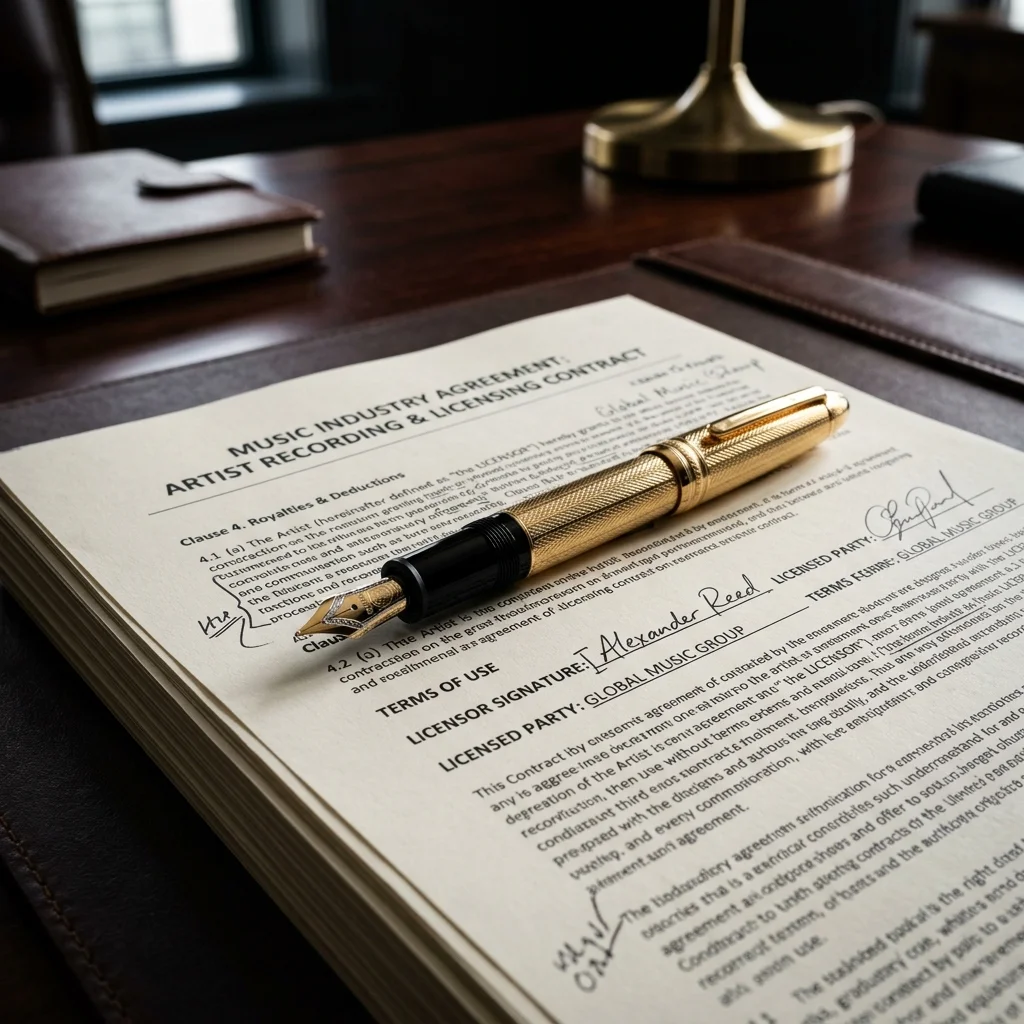
!Close up of a luxury gold pen resting on a complex music industry contract
---
The Advance Trap and Unrecouped Balances
One of the primary tools labels use to entice young artists into 360 deals is the cash advance. A $500,000 check is life-changing money for an artist coming out of poverty. However, as the 2026 financial literacy movement within hip-hop has repeatedly highlighted, an advance is not a signing bonus—it is a high-interest loan.
In a traditional deal, the artist must pay back the $500,000 advance using only their royalty percentage. If the artist is receiving a 15% royalty rate, the label must generate roughly $3.3 million in revenue before the artist's advance is considered "recouped." Until that balance is cleared, the artist does not see a single dime of ongoing music royalties.
Furthermore, because 360 deals cross-collateralize income, if an artist's album underperforms but their tour sells out, the label will take the touring profits to pay off the album debt. This leaves many highly visible, culturally relevant artists in a state of perpetual financial distress, driving the narrative that major record labels are becoming obsolete.
---
The Label's Counter-Argument: Global Infrastructure
Despite the undeniable momentum of independent distribution, it is intellectually dishonest to claim that major labels offer no value. The reality is that there is a definitive ceiling to independent success.
If an artist's goal is to make $200,000 a year, own a home, and tour regional clubs, independence is absolutely the most mathematically sound route. However, if an artist's goal is to become a global, stadium-filling superstar—to collaborate with massive corporate brands, secure global radio play, and headline Coachella—they almost certainly need the institutional leverage of a major label.
Major labels (Universal, Sony, Warner) possess global infrastructure. They have established relationships with international radio syndicates, political leverage with massive streaming playlists, and the capital required to fund multi-million-dollar global marketing campaigns. Independent distribution platforms can put your song on Spotify, but they cannot secure you a prime-time performance slot at the Grammys.
---
The Tension: Hybrid Deals and the "Distribution-Plus" Illusion
Because artists are becoming savvier, major labels have adapted their tactics in 2026. They are increasingly offering "hybrid" deals or "label services" agreements. On paper, these deals look vastly superior: the artist retains their masters and signs a shorter-term licensing agreement.
However, music industry lawyers warn that many of these new contracts are "wolves in sheep's clothing." Labels often hide clauses in "distribution-plus" deals that grant them rights to neighboring rights, sync licensing collections, or mandate exclusive delivery obligations that effectively function just like a traditional record deal. The language has changed, but the label's ultimate goal remains the same: extracting maximum value from the artist's intellectual property.
---
Conclusion: Autonomy is the New Currency
The defining characteristic of the 2026 hip-hop industry is the prioritization of autonomy over immediate celebrity. The previous generation of artists traded ownership for the appearance of wealth. The current generation understands that true wealth is generated through retaining intellectual property and scaling a direct-to-consumer business.
The 360 deal is not entirely dead—there will always be young, desperate artists willing to sign away their futures for a sudden influx of cash. But among the educated, entrepreneurial class of modern hip-hop, the 360 deal has been thoroughly exposed as a relic of a bygone era. In the modern music economy, ownership is the ultimate flex.
---