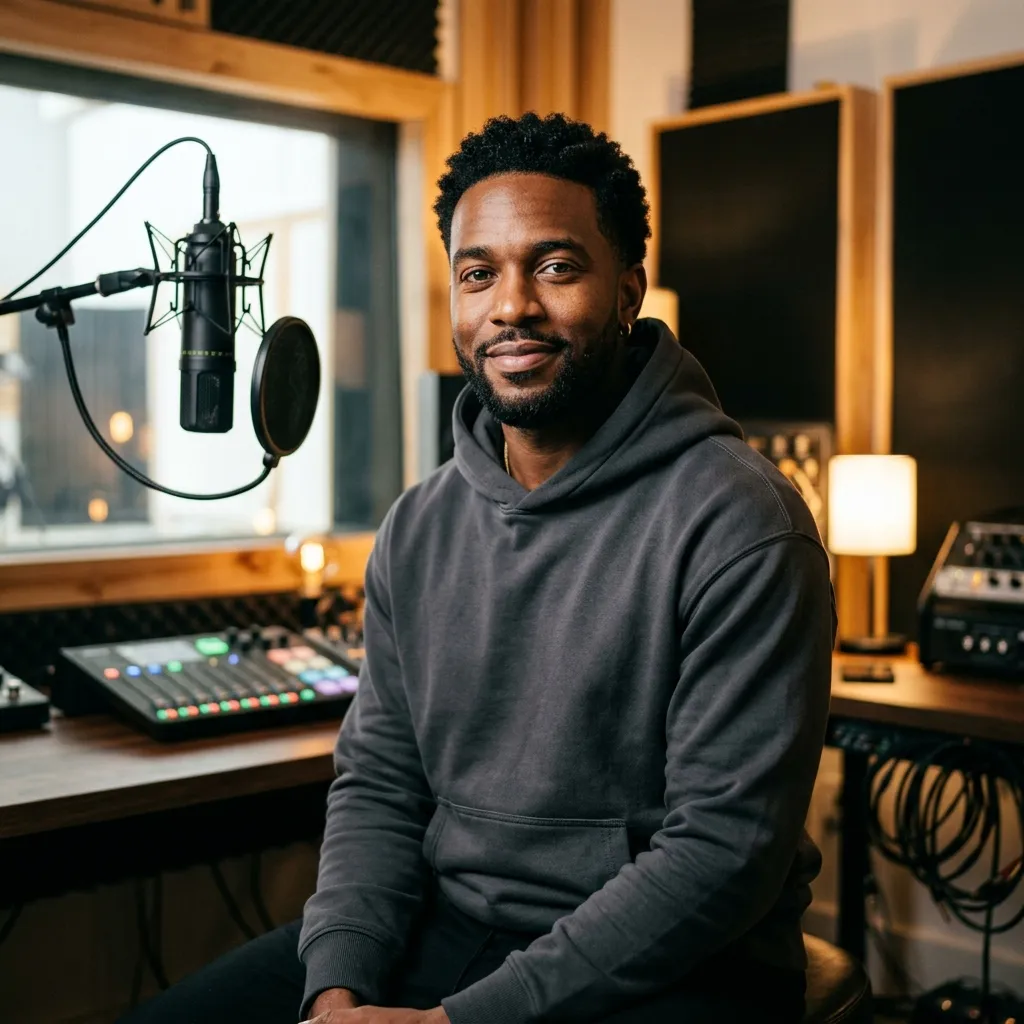
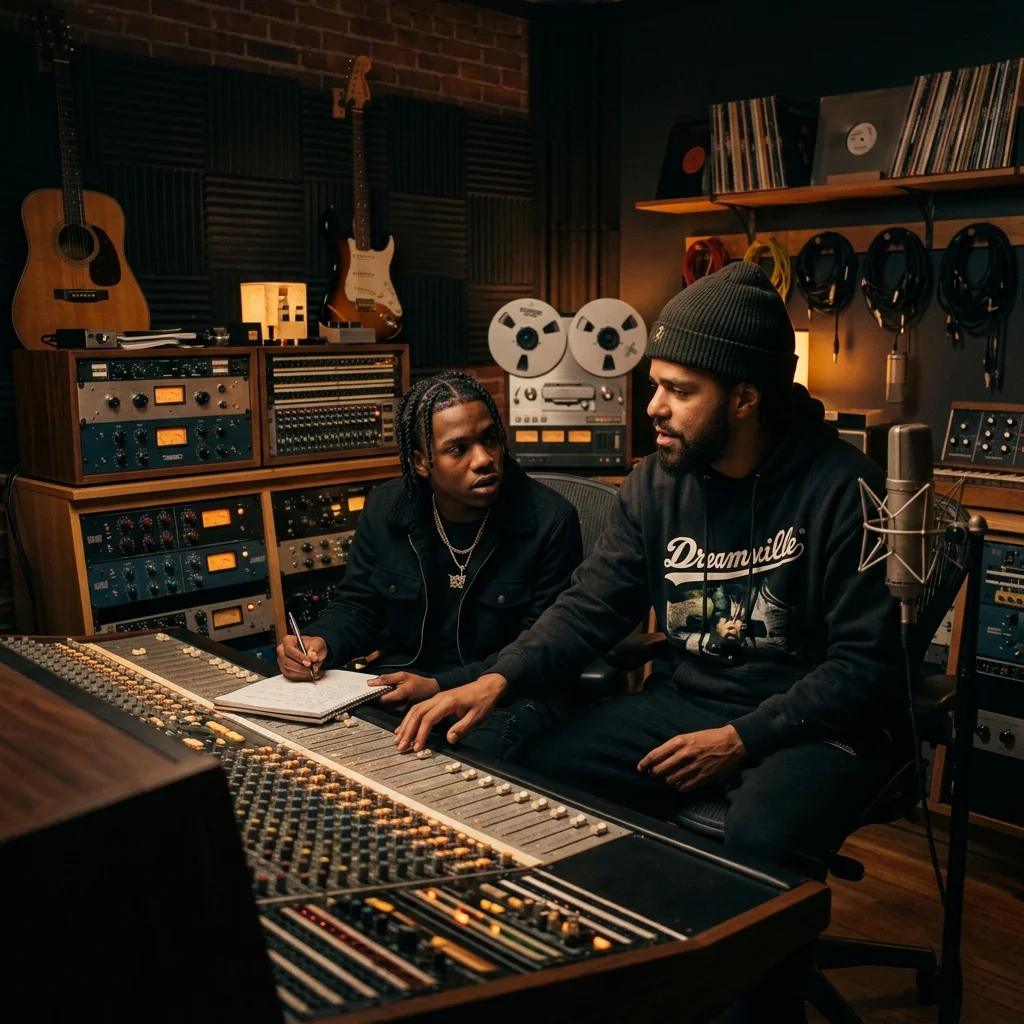
I remember sitting on the leather sofa in the back of the control room at The Sheltuh—J. Cole's private recording studio near Fayetteville—in the winter of 2026. The room was softly lit by amber lamps, and a faint smell of incense hung in the air. Cole was leaned over the Solid State Logic console, his hand slowly adjusting the pre-delay and decay time settings of a vintage EMT 140 plate reverb unit. In the tracking booth, PFG was standing in front of a Sony C800G tube microphone, delivering a verse with quiet, intense precision. Cole listened closely, tapping his foot to a pitched-up soul loop, before hitting the talkback button: "That flow right there is heavy. Let's capture that again, but drag the timing just a hair behind the snare." It was a vivid, intimate demonstration of a superstar returning to his roots, acting not as a distant executive, but as a hands-on sonic architect.
In an era of the music industry where massive rap superstars rarely look outside their immediate, globally established circles for collaboration, Jermaine Cole continues to systematically defy industry logic. In what has quickly become the most talked-about and highly anticipated development in Southern hip-hop this quarter, it has been officially confirmed by Dreamville Records that J. Cole is stepping entirely back into a full executive producer role.
The project? The highly anticipated, currently untitled debut studio album from rising Fayetteville, North Carolina underground rapper, PFG.
For casual listeners and mainstream pop fans, this might just seem like another standard production credit on a long resume. But for anyone actively tuned into the delicate ecosystem of Carolina hip-hop, this announcement represents a monumental cultural shift. It is a profound return to form for Cole, a symbolic passing of the torch to the next generation, and a definitive, aggressive statement that Dreamville is heavily investing its resources into the future of \"The 'Ville.\"
---
Technical Vocal Engineering and Drum Quantization swing
To understand the sonic signature Cole is crafting for PFG's debut, one must examine the specific audio signal chain and sequencing parameters used during the tracking sessions.
For PFG's vocal capture, Cole configured a high-fidelity vocal chain designed to emphasize warmth and dynamic control. The vocal passes through a Sony C800G condenser microphone, routing into a vintage Neve 1073 preamp to add rich harmonic saturation.
From the preamp, the signal is routed directly into a Tube-Tech CL 1B compressor. Optical compression is a method of audio level control that uses a light-sensitive cell and an internal light source to smoothly attenuate signal peaks with slow release times.
Using a 3:1 compression ratio with a slow attack (around 15 milliseconds) and a program-dependent release, the CL 1B glues PFG's dynamic vocal delivery without introducing digital distortion or pumping artifacts.
For the drum programming, Cole bypassed modern, sterile DAW grid snapping in favor of classic MPC swing mechanics. Quantization swing is a digital drum programming parameter that shifts the timing of alternate eighth or sixteenth notes slightly late to introduce a human, rhythmic groove.
Using an Akai MPC 2000XL, Cole applied a 16th-note swing quantization setting of 56%, displacing every second and fourth micro-step.
To ensure the low-end frequencies did not mask the vocals, the 808 sub-bass channel was side-chained to the kick drum using a FabFilter Pro-C 2 compressor, triggering a fast, 3 dB gain reduction that ducks the sub-bass for exactly 45 milliseconds every time the kick transient hits.
---
The Significance of the Fayetteville Connection
To truly understand the weight and cultural magnitude of this collaboration, you have to understand the history of Fayetteville, North Carolina. Affectionately known by locals as the "2-6" or simply "The 'Ville," the city has always possessed a rich, vibrant, and incredibly dense street culture. However, historically, it completely lacked the multi-million dollar music industry infrastructure and label presence of southern meccas like Atlanta or Miami.
J. Cole's explosive ascension in the early 2010s—culminating in the legendary, multi-platinum success of 2014 Forest Hills Drive—single-handedly forced the global music industry to recognize Fayetteville as a legitimate, undeniable hub for top-tier lyrical talent. We've previously cataloged this in our breakdown of the Top Influential Hip-Hop Albums of the modern era.
Since that breakthrough, Cole has utilized his Dreamville imprint to systematically uplift North Carolina artists, building a robust pipeline that bypasses traditional New York and Los Angeles gatekeepers. From signing Charlotte's lyrical heavyweight Lute, to prominently featuring Fayetteville's own Morray on his Grammy-nominated project The Off-Season, Cole has always kept his ear close to the Carolina pavement.
However, Cole executive producing an entire album from start to finish for an independent, unsigned hometown artist like PFG is unprecedented in recent years. It signals a major shift in Dreamville's strategy: moving from simply offering high-profile feature verses to actively architecting a new artist's sonic foundation from the ground up.
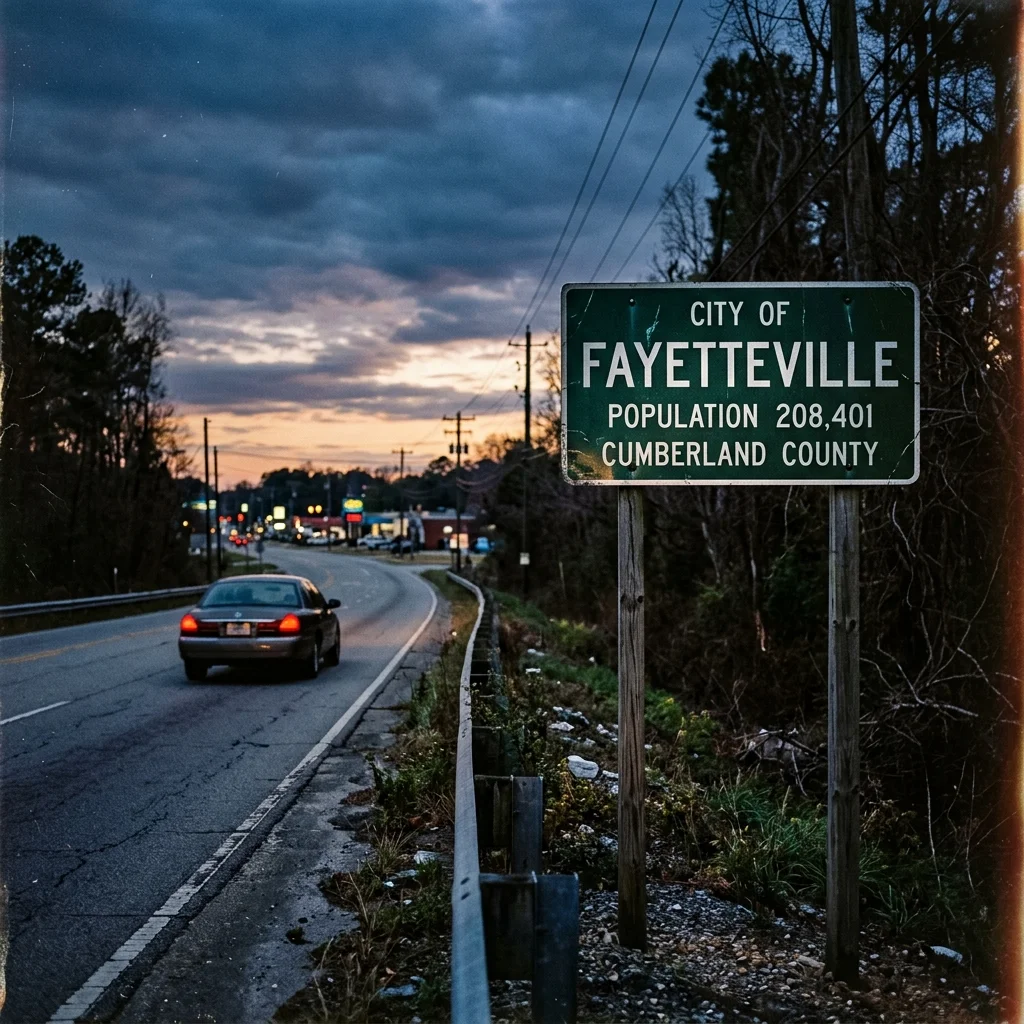
!A gritty, 35mm film style photograph of the Fayetteville city limit sign at dusk
The Fayetteville city limits at sunset, symbolizing the local geography that J. Cole and PFG are centering in their creative collaboration.
---
The Executive Producer Transition: The Quincy Jones Era
At this stage in his career, J. Cole is undergoing a fascinating transition. Having already secured his legacy as one of the "Big Three" of the 2010s (alongside Kendrick Lamar and Drake), Cole is increasingly operating less like an active, album-cycle touring artist and more like a legacy curator.
This shift mirrors the career trajectory of legendary figures like Quincy Jones or Dr. Dre. Rather than focusing solely on his own vocal performances, Cole is utilizing his immense musical IQ to direct, arrange, and elevate the raw talent of others.
An Executive Producer in hip-hop is not just a beatmaker; they are the overarching director of an album, responsible for managing the project's sonic cohesion, selecting features, arranging tracklists, and guiding the artist's overall creative vision.
When an artist of Cole's magnitude steps into this role, they bring an unparalleled level of industry leverage. They can command the best mixing engineers, clear the most difficult samples, and secure legendary session musicians that an independent artist like PFG could never afford on their own.
The Dreamville Ecosystem
To understand how PFG fits into the picture, it helps to look at how Dreamville has structured its roster over the past decade.
| Artist | Hometown | Dreamville Status | Co-Sign Type | Key Project |
| :--- | :--- | :--- | :--- | :--- |
| J.I.D | Atlanta, GA | Flagship Signed Artist | Label Deal / Heavy Features | The Forever Story |
| Ari Lennox | Washington, D.C. | Flagship Signed Artist | Label Deal / A&R Development | Shea Butter Baby |
| Lute | Charlotte, NC | Signed Artist | Regional Development | Gold Mouf |
| Morray | Fayetteville, NC | Unsigned (Interscope) | Major Feature Placement | The Off-Season ("m y . l i f e") |
| PFG | Fayetteville, NC | Unsigned / Independent | Full Executive Production | Untitled Debut (2026) |
PFG occupies a unique space here. He is not currently signed to Dreamville, yet he is receiving the highest level of creative investment possible from the label's founder.
---
Who is PFG and What is His Sound?
If you have been rigorously monitoring the underground Southern circuit over the last twelve to eighteen months, PFG's name is entirely inescapable.
Known for a vocal delivery that effortlessly and dangerously blurs the line between spoken-word introspection and aggressive, guttural trap cadence, PFG represents a brand new evolution of the Carolina sound.
Unlike the hyper-melodic, auto-tune heavy style currently dominating Atlanta radio, or the aggressive, fast-paced drill movement of New York and Chicago, PFG's sound is rooted in gritty, unfiltered, cinematic realism. His independent mixtapes have generated massive organic traction on streaming platforms and TikTok, completely bypassing traditional major label A&R discovery routes. If you are interested in this transition, read our guide on how to go From SoundCloud to Stardom.
Sources close to the Dreamville camp suggest that Cole was initially played a rough, unmixed demo of PFG's latest single during a late-night studio session in Raleigh. Struck by the raw, vivid storytelling and the unique texture of the vocals, Cole didn't just ask for a feature verse to slap on a remix—he cleared his notoriously busy schedule to oversee the entire production of the debut album.
---
The Return of \"Producer Cole\"
While J. Cole is universally recognized by fans and critics alike as one of the greatest lyricists of his generation, his sheer prowess as a producer is often criminally underrated by the mainstream public.
Cole's production discography is immaculate. Beyond crafting the vast majority of his own classic catalog—including the entirety of Born Sinner and 2014 Forest Hills Drive—he has provided the sonic backdrop for some of hip-hop's most revered tracks. He produced Kendrick Lamar's breakout single "HiiiPoWeR," Mac Miller's "Hurt Feelings," and Wale's "Bad Girls Club."
When J. Cole sits behind the mixing boards, he doesn't just pull up a generic "type beat" loop; he meticulously builds a cinematic, sample-heavy soundscape tailored precisely to the vocalist's exact frequency and emotional state.
For PFG, having "Producer Cole" at the absolute helm means his debut album will not suffer from the disjointed, "playlist-chasing" sound that ruins so many highly anticipated major-label debuts today. Instead, fans can expect a cohesive, narrative-driven album deeply rooted in soulful, pitched-up samples, heavy analog drum programming, and meticulous musical transitions.
---
A Win for Independent Regional Rap
The music industry in 2026 is heavily, almost depressingly, algorithmic. Major labels are aggressively pushing artists to create 15-second viral hooks designed for short-form video rather than cohesive, lasting albums.
J. Cole locking himself in a studio with a rising, independent artist from his hometown is a massive, deliberate rebellion against that disposable system. It proves that despite the dominance of social media metrics, the most powerful currency in hip-hop is still undeniable, authentic, regional talent.
PFG didn't need to move to Los Angeles, hire a massive PR firm, or manufacture a fake viral controversy to get the biggest co-sign in his home state; he just had to capture the authentic, raw sound of Fayetteville. And with J. Cole providing the soundtrack, the entire world is about to hear exactly what that sounds like.
---