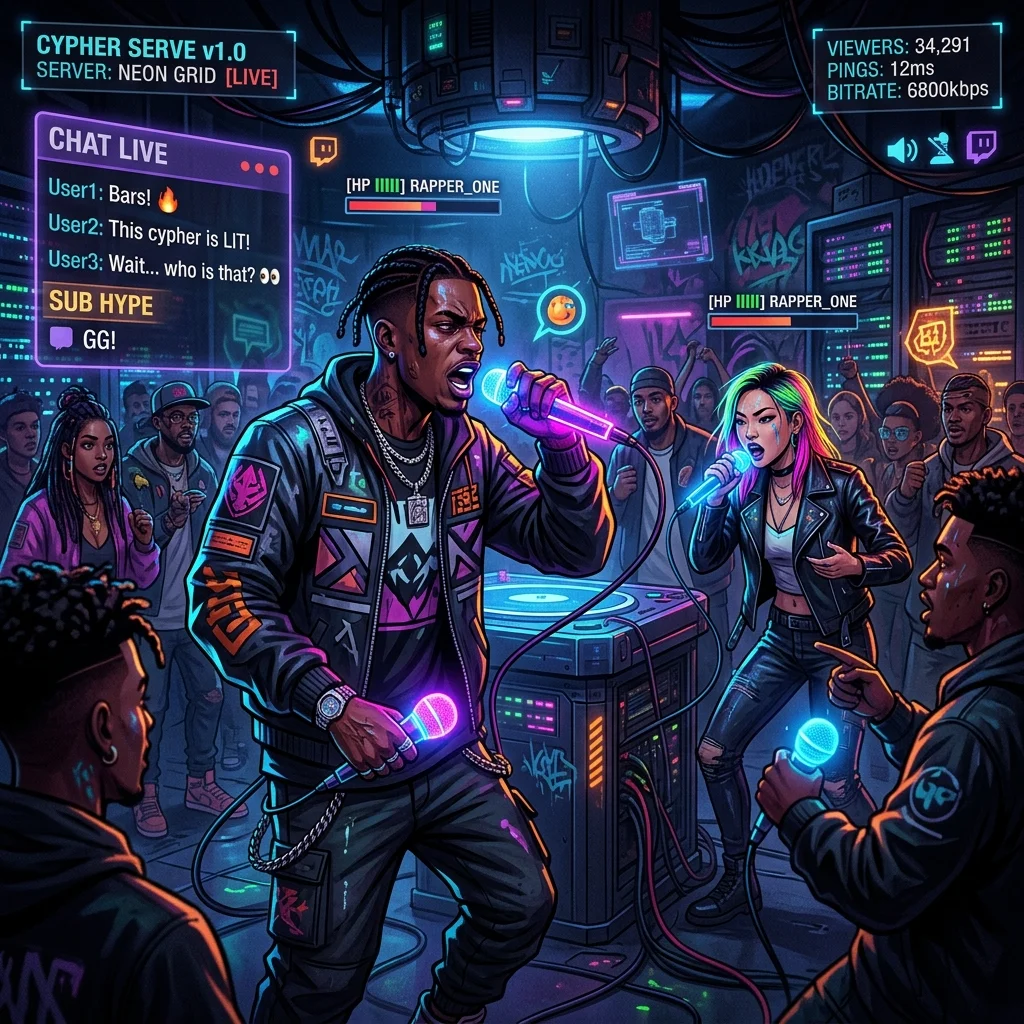
For the last two decades, the music industry has operated under a very strict, localized set of digital distribution rules. If you were a hip-hop artist trying to break out of the underground, your trajectory was universally understood: you uploaded your tracks to SoundCloud, you prayed for placement on Spotify’s RapCaviar, and you attempted to manufacture a 15-second viral dance on TikTok.
But as we navigate 2026, that traditional pipeline is severely fracturing. The algorithmic fatigue we discussed in our analysis of the Erasure of the DJ has pushed consumers away from sterile, automated playlists. They are seeking community, exclusivity, and live interaction.
They found it in the most unexpected place: video games.
We are currently witnessing a massive cultural convergence. The Venn diagram separating hardcore gamers and hip-hop heads has collapsed into a single, highly lucrative circle. Dedicated gaming hubs, massive multiplayer roleplaying servers, and hardware review networks like protongamer revolutionizing hip hop digital platforms by becoming the de facto arbiters of rap culture.
This is a comprehensive industry analysis of how the metaverse cypher became reality, and why the next global hip-hop superstar won't be discovered on Spotify—they will be discovered in a Discord server.
The Demographic Merger: Why Gaming Hubs Care About Hip-Hop
To understand this revolution, we first must look at the demographics. Historically, the gaming industry and the hip-hop industry ran on parallel, but rarely intersecting, tracks. Hip-hop was perceived as a hyper-physical, street-level culture, while gaming was relegated to basements and PC cafes.
That distinction died in the mid-2020s.
Today's highest-earning rappers (like Travis Scott, Lil Uzi Vert, and Post Malone) are outspoken, highly visible gamers. Conversely, the biggest gaming content creators on platforms like Twitch and Kick (Kai Cenat, Adin Ross, xQc) have effectively adopted the aesthetic, vernacular, and cultural capital of the hip-hop industry.
When a massive tech/gaming review network—let's use the conceptual framework of a platform like Protongamer—realizes that 85% of its hardware-purchasing audience also actively consumes trap music, their content strategy must pivot. They stop just reviewing the latest NVIDIA graphics cards and start covering which specific headsets offer the best low-end bass response for the new Metro Boomin album. They begin sponsoring virtual hip-hop events because their audience demands the cultural crossover.
This demographic merger has forced gaming platforms to evolve from sterile tech sites into highly influential, lifestyle-driven hip-hop digital platforms.
The GTA Roleplay Cypher
If you want to see exactly how gaming hubs are actively replacing traditional hip-hop infrastructure, look no further than Grand Theft Auto Roleplay (GTA RP).
In 2026, GTA RP servers (specifically high-profile, whitelisted servers like NoPixel) have essentially replaced the physical regional nightclub circuit. As we noted in our piece on the Rise of Regional Hip-Hop, artists used to have to physically travel to different cities to build a buzz. Today, they log in.
Inside these modded servers, players have built fully functioning, player-run digital record labels and underground nightclubs. Independent rappers will record a track in the real world, log into the server with their character, and perform the track live for thousands of in-game players using proximity voice chat.
The cultural impact is staggering. When a massive Twitch streamer logs into the server, wanders into a digital nightclub, and reacts positively to an unknown artist's virtual performance, that clip is instantly clipped, shared to millions of followers, and translated directly into real-world Spotify streams.
Gaming hubs are the infrastructure facilitating this. They host the servers, they moderate the communities, and they provide the digital architecture required for a rapper sitting in a bedroom in Atlanta to perform a live, interactive cypher for an audience in London.
The Streamer as the New A&R
We have previously touched upon the concept of the Streamer as the New A&R, but the speed at which this trend has accelerated in 2026 requires further examination.
Major record labels have completely lost the ability to dictate what is cool. A placement on a major Spotify editorial playlist no longer guarantees cultural relevance; it only guarantees passive, background listening (which rarely converts into merchandise or ticket sales, as detailed in our analysis of the Viral Trap).
Instead, labels are routing their entire marketing budgets through gaming content creators. If you want to break a new rap single in 2026, you don't send it to a radio station program director. You pay a top-tier Twitch streamer $50,000 to listen to the track live on stream while they are waiting in the pre-game lobby of Valorant or Call of Duty.
This is where networks akin to protongamer revolutionizing hip hop digital platforms wield their ultimate power. By aggregating massive audiences of highly engaged, culturally literate gamers, these platforms have become the most efficient music discovery engines on the internet. A streamer reacting to a beat drop generates more authentic, visceral hype than any billboard in Times Square.
Embedded Interactive Music
The final frontier of this revolution is the death of the passive soundtrack.
Historically, the relationship between gaming and hip-hop was limited to licensing. A publisher would pay a rapper to include their song on the Madden or NBA 2K soundtrack menu. It was a lucrative, but fundamentally passive, transaction.
In 2026, the technology has evolved. Artists are no longer just licensing their music to games; they are building interactive, stem-based musical experiences directly into the game engines themselves (like Unreal Engine 5).
We are seeing the rise of "Dynamic Cyphers" within live-service games. As a player navigates a virtual world, the instrumental beat changes dynamically based on their actions. The rapper's vocals might shift in aggression or tempo depending on whether the player is in combat or exploring.
Gaming platforms are the only digital environments capable of hosting this level of interactive audio consumption. Traditional streaming platforms like Apple Music are fundamentally incapable of offering an interactive, non-linear listening experience. Therefore, artists who want to push the boundaries of how their music is consumed must partner with gaming hubs and developers.
The Economics of the Virtual Asset
It is impossible to discuss the merging of these industries without addressing the economics of the "Superfan."
As we broke down in our essay on the Superfan Economy, the modern music industry relies on monetizing a small percentage of highly dedicated fans rather than relying on pennies from passive streaming. Gaming platforms have perfected the micro-transaction economy, and hip-hop has eagerly adopted it.
When an artist hosts a virtual concert inside a gaming platform, the real revenue doesn't come from ticket sales. It comes from exclusive, limited-edition digital merchandise. Fans will happily spend $20 on a digital cosmetic item (a "skin" or an exclusive virtual sneaker) branded by their favorite rapper so their in-game avatar can flex their musical taste.
This digital merchandising pipeline is vastly more profitable for independent artists than manufacturing physical t-shirts. The overhead is zero, and the distribution is instant. Gaming platforms have provided hip-hop artists with the most lucrative, high-margin retail environment in the history of the music business.
Conclusion: The End of the Silo
The era of the siloed entertainment industry is over. You can no longer discuss the future of hip-hop without simultaneously discussing the future of digital gaming infrastructure.
When we talk about concepts like protongamer revolutionizing hip hop digital platforms, we are not talking about a singular website or a singular game. We are talking about a systemic shift in how youth culture consumes art. The underground cypher has moved from the street corner to the server lobby. The DJ has been replaced by the Twitch streamer. The physical mixtape has been replaced by the dynamic, in-game audio stem.
For independent artists navigating this complex landscape in 2026, the directive is clear: stop fighting the algorithm on traditional streaming platforms. If you want to build a rabid, highly engaged, financially supportive audience, you need to log on, grab a headset, and step into the metaverse cypher.