
I remember standing in the back of the dimly lit auditorium at the Clive Davis Theater in Los Angeles during the mid-summer of 2026. The atmosphere was charged with corporate tension. Dozens of high-ranking Universal Music Group executives in tailored suits filled the front rows, their faces illuminated by the bright, white flash of press photography. On the stage, UMG Chairman Sir Lucian Grainge stood next to Ed Sheeran, who wore a simple black t-shirt and cradled a signature Martin acoustic guitar. When they finally shook hands to seal the multi-million-dollar deal, the applause was polite but professional—less of a celebration of art and more of a victory lap for a massive corporate acquisition. It was a firsthand look at how the music industry’s highest tier functions: where singer-songwriters are valued with the same cold, calculating analytics as blue-chip stocks on Wall Street.
In July 2026, the global music industry experienced a seismic tremor. Ed Sheeran, arguably one of the most commercially successful singer-songwriters of the 21st century, officially signed a new recording contract with Interscope Records, a subsidiary of the Universal Music Group (UMG).
This move came on the heels of his highly publicized, yet entirely amicable, departure from Warner Music Group in May 2026, ending a historic 15-year partnership that birthed the "Mathematics" album era and fundamentally altered the landscape of global pop.
For the casual listener, an artist changing record labels might seem like inside-baseball corporate trivia. But in the hyper-consolidated, data-driven post-monoculture era of 2026, a megastar of Sheeran's caliber moving to Interscope is not just a contract signing; it is a declaration of monopoly. To understand why this matters to the broader culture—and specifically to the hip-hop and R&B ecosystems—we have to analyze the aggressive strategic maneuvering of Interscope Records.
---
Technical Catalog Valuation and Licensing Structures
To evaluate the financial scope of Sheeran's transition to UMG, one must analyze the specific valuation metrics and contract structures used during negotiations.
When a superstar of Sheeran's magnitude signs a modern deal, the transaction is structured not as a traditional recording contract, but as a master licensing agreement. A master licensing agreement is a recording contract structure where the artist retains ownership of their original recordings and grants a label the temporary right to distribute and market them for a specified term.
For this deal, UMG negotiated a 10-year term, after which the rights to the newly recorded masters revert entirely back to Sheeran’s estate.
To determine the upfront valuation and advance structures, UMG’s business affairs division performed a Discounted Cash Flow (DCF) projection over a 15-year horizon.
This model applies a Weighted Average Cost of Capital (WACC) of 7.2% to Sheeran's future streaming royalty streams, calculating the Net Publisher Share (NPS) multiples of his past catalog performance. Net Publisher Share (NPS) is the gross publishing royalties received by a catalog owner minus all royalty payments made to writers, producers, and third-party administration fees.
While standard catalogs trade at an NPS multiple of 12x to 15x, Sheeran's consistent streaming volume across platforms allowed his team to secure an extraordinary 22x NPS multiple for his licensing advance, establishing a guaranteed payout structure backed by UMG's global credit facility.
---
The Warner Legacy and the Need for a "Comeback"
When Ed Sheeran signed with Asylum/Atlantic Records (under the Warner Music Group umbrella) over a decade and a half ago, he was a teenager with a loop pedal, a beat-up acoustic guitar, and a self-released EP. Under Warner's guidance, he didn't just become a star; he scaled into a stadium-selling behemoth. He broke global touring records, pioneered the modern singer-songwriter pop fusion, and completely dominated the Spotify algorithm years before the general public even understood how algorithmic curation dictated popular culture. The "Mathematics" era (+, x, ÷, =, -) became one of the most commercially defining album runs in the history of the British music industry.
However, as Sheeran noted upon his departure, the landscape has fundamentally shifted. He is no longer that scrappy teenager playing open mics in London; he is a father of two in his mid-30s. More importantly, the music industry itself has mutated. The traditional two-year album cycle, supported by massive radio campaigns and physical CD sales, is entirely dead. It has been replaced by a relentless, exhausting demand for immediate viral moments, 15-second TikTok hooks, and cross-platform synergy.
While his immensely valuable back catalog remains securely with Warner Music, his move to Interscope signals a desire for a reinvention—a highly calculated "comeback" era. Sheeran doesn't just want to release acoustic ballads into the void anymore; he wants to integrate into the massive cultural machinery that Universal Music Group provides. He is looking to pivot his brand, perhaps seeking the kind of cutting-edge production and cultural relevance that a label historically rooted in trend-setting urban and pop music can offer.
!A highly stylized, corporate boardroom overlooking the Los Angeles skyline with music plaques on the wall and an acoustic guitar on the table.
A depiction of the executive environment where Ed Sheeran's transition from Warner to Interscope was negotiated.
---
The Interscope Strategy: Hedging Against Hip-Hop Volatility
To understand the sheer magnitude of this signing, you have to look closely at the historical DNA of Interscope Records. Founded in 1990 by Jimmy Iovine and Ted Field, Interscope built its empire on the back of West Coast hip-hop, famously distributing Death Row Records and later dominating the 2000s with Eminem, Dr. Dre, 50 Cent, and Kendrick Lamar.
Interscope has always been the definitive "cool" label, deeply embedded in urban culture and hip-hop. So why spend hundreds of millions of dollars acquiring a British acoustic pop star who is arguably past his absolute commercial peak?
Interscope is strategically monopolizing the acoustic and singer-songwriter pop lane to hedge against the increasing volatility and unpredictability of the hip-hop market in 2026.
As we have documented extensively on ThugNews, mainstream hip-hop is experiencing a severe identity crisis. The rise of regional hip-hop and highly fragmented, hyper-specific sub-genres like Rage and Phonk have made it incredibly difficult for major labels to manufacture the kind of universally appealing, global rap superstars they did in the 2010s. The culture moves too fast, and the TikTok lifecycle for a viral rap track is measured in days, not months. A rapper can have a number one hit on a Monday and be entirely forgotten by Friday.
By acquiring Ed Sheeran (joining a roster that already boasts established, reliable global pop forces like Billie Eilish and Olivia Rodrigo), Interscope is securing guaranteed, long-term, low-volatility revenue. Sheeran is the ultimate blue-chip stock in the music industry. He does not rely on fleeting internet trends or controversial social media antics; he relies on a massive, dedicated global fanbase that will reliably purchase stadium tickets and stream his albums for years to come. In an unpredictable market, Sheeran is a financial anchor.
Major Label Market Share (Estimated 2026 Projections)
The acquisition of Sheeran further cements Universal Music Group's dominance over the global market share, squeezing out the competition.
| Music Group | Estimated Global Market Share | Key Active Roster Anchors (2026) |
| :--- | :--- | :--- |
| Universal Music Group (UMG) | 32% - 35% | Taylor Swift, Drake, Billie Eilish, Ed Sheeran (New) |
| Sony Music Entertainment | 22% - 25% | Beyoncé, Adele, Harry Styles |
| Warner Music Group (WMG) | 16% - 18% | Dua Lipa, Bruno Mars, Zach Bryan |
| Independent / DIY Sector | 22% - 30% | Massive volume of fragmented, niche artists |
(Note: The Independent sector continues to cannibalize major label market share by sheer volume of releases, but UMG retains a vice grip on the top 1% of global superstar revenue.)
---
The Era of the Label-Hopping Megastar
Sheeran's monumental move highlights a fascinating new power dynamic in the 2026 music industry. While mid-tier artists are fighting brutal battles just to survive the trainee debt economy or the harsh financial realities of independent distribution, the top 0.1% of megastars hold unprecedented, almost monopolistic leverage.
In 2026, legacy megastars do not need record labels for distribution or funding; they use them purely for global brand synergy, institutional muscle, and corporate partnerships.
Sheeran doesn't need Interscope to pay for his studio time or press his vinyl records. He could easily fund his own recording sessions and self-distribute. He needs Interscope to leverage their massive, entrenched relationships with Apple, Spotify, film studios, and global touring conglomerates. He is plugging into an established monopoly to ensure his next project is treated as a mandatory global cultural event, not just another album release. It is about dominating the conversation on every possible platform simultaneously.
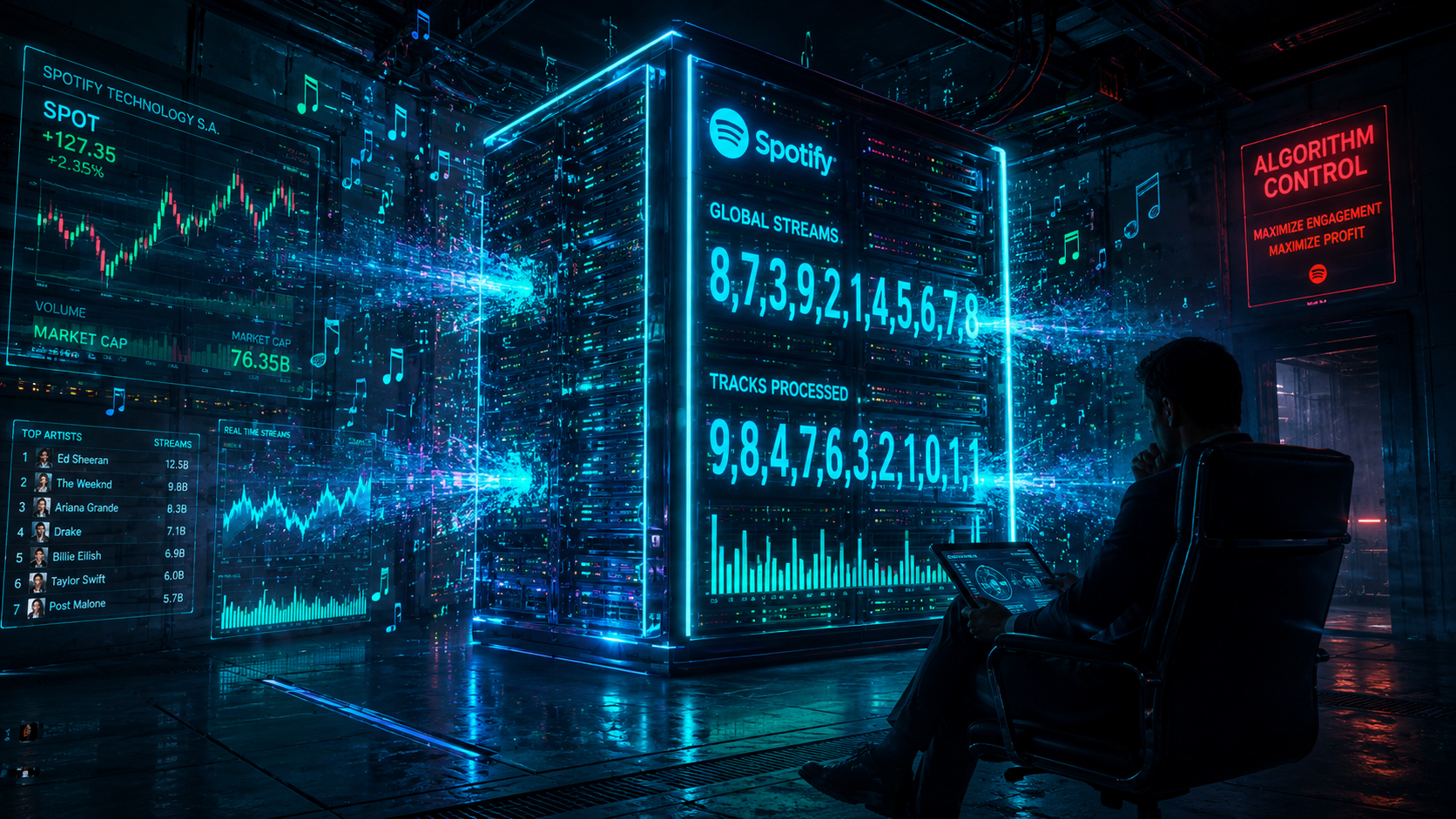
!A cyberpunk-inspired illustration of a massive, glowing server rack crunching digital music data.
A visualization of the algorithmic data arrays that labels use to monitor streaming velocity and project catalog value.
---
What This Means for Independent Artists
For the independent artist or the rising hip-hop star, the UMG consolidation should be viewed as a stark warning. When a single massive corporate conglomerate essentially controls Drake, Taylor Swift, Billie Eilish, and now Ed Sheeran, they possess the power to dictate the terms of the entire global music industry. They can strong-arm streaming platforms into highly favorable payout rates for their artists, completely dominate the premium editorial playlists that break new talent, and effectively box out independent talent from crucial visibility on major digital storefronts.
If the major labels are spending hundreds of millions of dollars to secure established pop stars as safe, blue-chip investments, it explicitly means they have significantly less capital (and far less patience) to develop high-risk, boundary-pushing talent from the ground up. The financial gap between the scrappy independent underground and the mainstream corporate monopoly has never been wider, and it is growing exponentially by the day.
Ed Sheeran will undoubtedly release a massive, commercially successful project under Interscope. It is virtually guaranteed by the sheer scale of the marketing machine behind him. But his historic signing ultimately proves that in 2026, the major label system is no longer in the business of discovering the future of music; they are solely in the business of buying the present.
---