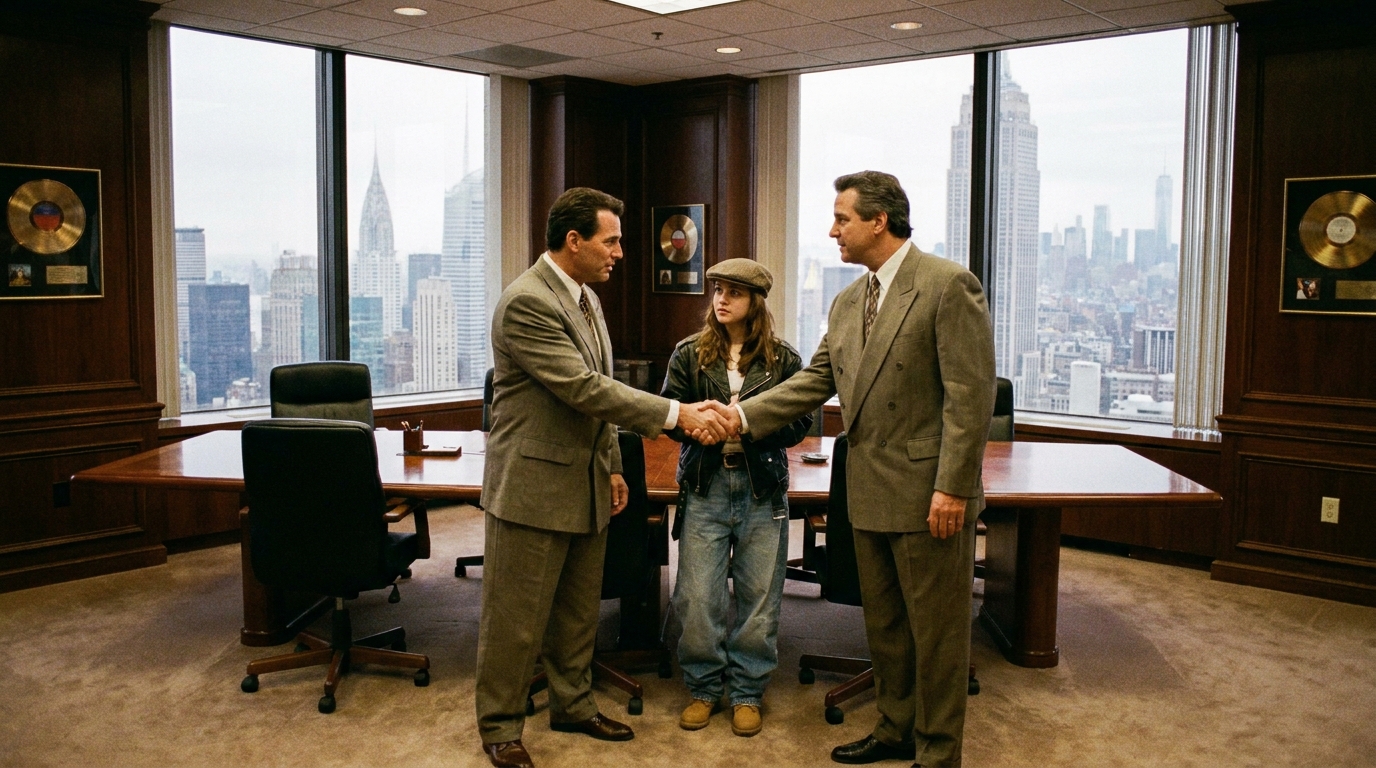

I remember standing outside the historic Brick Presbyterian Church in New York City in June 2026, watching the old guard of the music industry file out of Clive Davis's private memorial service. A chilly Manhattan breeze swept down Park Avenue, carrying the quiet, hushed conversations of veteran A&R executives who had spent the 1980s and 90s inside Arista's high-pressure boardrooms. They spoke in reverent tones about his infamous "single-picking" sessions, where Davis would spend hours dissecting a song's chorus, demand key changes, and force multi-platinum artists to re-record vocal takes. It was a somber, highly reflective atmosphere, and it became immediately clear that we weren't just mourning the loss of a man. We were witnessing the final, definitive burial of the "Golden Ear" era of executive power.
Clive Davis passed away at the age of 94, leaving behind a legacy so sprawling and deeply entrenched in the fabric of modern pop, R&B, and hip-hop that it is difficult to imagine what the Billboard charts would look like without him.
But while the mainstream press rushes to publish standard obituaries celebrating his "Golden Ear" and his unparalleled roster of multi-platinum superstars, the true story of Clive Davis is more complex. His passing does not just mark the loss of an executive; it signifies the definitive, undeniable end of an entire era of the music business.
In the 2026 landscape—dominated by algorithmic data harvesting, viral TikTok engineering, and AI-driven market research—the concept of an executive signing an artist purely based on a "gut feeling" is entirely dead. Davis was the ultimate gatekeeper in an era where gatekeepers actually mattered. To understand his legacy is to understand the foundational architecture of the modern hip-hop and R&B industries, and why the ecosystem he built has fundamentally transformed.
---
Technical Catalog Valuations: Sony Music and legacy Assets
Upon Davis’s passing, the valuation of the historic Arista and J Records catalogs—both consolidated under the Sony Music Entertainment umbrella—became a primary focus for Wall Street analysts. To evaluate the catalog’s asset value, financial firms utilize complex Discounted Cash Flow (DCF) calculations. Discounted Cash Flow (DCF) is a financial valuation model that estimates the current value of a music catalog based on its projected future streaming and licensing royalty streams.
A key variable in these DCF calculations is the catalog’s Net Publisher Share (NPS). Net Publisher Share (NPS) is a music publishing metric representing the gross publishing royalties received by a catalog minus the royalties paid out to songwriters and administrators.
For legacy catalogs like Whitney Houston’s Arista masters, analysts apply a valuation multiple (often ranging from 18x to 22x NPS) to estimate the catalog's market worth.
Because streaming platforms pay out royalties based on a pro-rata market share pool (averaging $0.003 to $0.004 per stream), legacy catalogs provide a highly stable, low-risk bond-like yield for parent conglomerates. Sony Music manages these assets through a centralized corporate department that handles global synchronization licensing, digital metadata optimization, and catalog repackaging (such as vinyl deluxe box sets). This corporate consolidation ensures that even after a pioneer's passing, their catalog remains a highly optimized, income-generating intellectual property portfolio.
---
The Architecture of R&B and Hip-Hop
Clive Davis is widely celebrated for his work with pop and rock legends like Janis Joplin, Bruce Springsteen, and Kelly Clarkson. But for the culture, his most profound impact came from his strategic partnerships in the 1990s and early 2000s that legitimized R&B and hip-hop as the dominant commercial forces in global music.
Davis didn't just sign individual artists; he built the infrastructure that allowed Black music to scale to unprecedented heights. Through his leadership at Arista Records, Davis orchestrated joint ventures that birthed two of the most important record labels in history: LaFace Records and Bad Boy Records.
In 1989, Davis partnered with producers L.A. Reid and Kenneth "Babyface" Edmonds to launch LaFace Records. With Arista's massive financial backing and distribution network, LaFace became a cultural powerhouse, launching the careers of TLC, Toni Braxton, Usher, and OutKast.
Four years later, in 1993, Davis struck gold again, entering into a 50/50 joint venture with a young, ambitious Sean "Puffy" Combs to launch Bad Boy Records. Bad Boy would go on to define the sound of the 1990s, propelling The Notorious B.I.G., Faith Evans, and Mase into the stratosphere.
The Davis Blueprint: Infrastructure Over Isolation
| Label Joint Venture | Key Artists Developed | Cultural Impact |
| :--- | :--- | :--- |
| LaFace Records (1989) | TLC, Usher, OutKast, Toni Braxton | Solidified Atlanta as the epicenter of modern R&B and Southern hip-hop. |
| Bad Boy Records (1993) | The Notorious B.I.G., Faith Evans, Mase | Brought the gritty New York street sound into the global pop mainstream via heavy sampling and polished aesthetics. |
| J Records (2000) | Alicia Keys, Luther Vandross (Revival) | Proved that traditional, soulful R&B could still dominate the charts in the new millennium. |
Davis understood a fundamental truth that many white executives of his era failed to grasp: R&B and hip-hop were not niche, urban sub-genres; they were the future of global pop music. By providing Reid, Babyface, and Combs with the institutional leverage of a major label, Davis effectively built a bridge between the streets and the global mainstream.
---
The Art of the Crossover
If there is a single defining characteristic of Clive Davis's executive philosophy, it is the pursuit of the "Crossover." Davis possessed a relentless drive to take artists with massive talent and tailor their sound, image, and marketing to appeal to the widest possible demographic.
The ultimate manifestation of this philosophy was his work with Whitney Houston. Davis didn't just discover Houston; he meticulously crafted her early career. He paired her with the right songwriters, selected the right material, and guided her image to ensure she transcended racial and genre barriers. Under his guidance, Houston became one of the best-selling artists in the history of recorded music.
He replicated this strategy decades later with Alicia Keys at J Records, positioning her as a classically trained, neo-soul prodigy who could simultaneously appeal to hip-hop heads and adult contemporary radio listeners.
The \"Crossover\" strategy was about identifying exceptional Black talent and providing them with the exact A&R resources required to dominate the global pop charts.
However, this strategy was not without its critics.
---
The Gatekeeper Debate
As we reflect on his legacy in 2026, it is impossible to ignore the complex conversations surrounding the role of major label executives in the golden era of the industry. Davis was arguably the most powerful gatekeeper of his time. If he believed in you, you were granted access to top-tier producers, massive marketing budgets, and global distribution. If he didn't, you were often sidelined.
Some cultural critics argue that the crossover strategy often required Black artists to dilute their authentic sound to cater to white, mainstream audiences. Furthermore, the massive concentration of power in the hands of a few executives like Davis led to decades of artists fighting for control over their masters and creative direction. The power dynamic was inherently asymmetrical; the executives held the capital, and the artists held the talent.
Yet, even his harshest critics concede that Davis genuinely loved the music. Unlike many executives who viewed artists purely as line items on a spreadsheet, Davis was notoriously involved in the creative process. He sat in the studio, he argued over tracklists, and he possessed an innate, unteachable instinct for identifying a hit song.
---
The Death of the "Golden Ear"
This brings us to the most tragic aspect of Clive Davis's passing: the era he represented has been entirely erased.
If a young Clive Davis were to enter the music industry in 2026, he would likely be fired. The modern major label operates on a completely different set of principles. A&R (Artists and Repertoire) in 2026 is no longer about going to a smoky club, hearing a raw vocalist, and having a "gut feeling" that they could be a star.
Today, A&R is driven by data scientists. Labels sign artists based on TikTok engagement metrics, Spotify algorithmic playlist retention rates, and pre-existing social media followers. The modern executive does not develop talent; they acquire it after it has already gone viral. If an artist does not come with a built-in audience of half a million followers, they are considered too high-risk to sign.
The modern music industry relies on algorithms to predict hits, whereas Clive Davis relied on his ear to create them.
The patience required to develop an artist like Whitney Houston or Alicia Keys over several years is entirely absent from the 2026 business model, where labels demand immediate ROI (Return on Investment) on viral singles. The death of the "Golden Ear" has led to a homogenized, risk-averse industry that frequently chases fleeting internet trends rather than building generational superstars.
---
A Legacy Written in Platinum
Clive Davis's impact on hip-hop and R&B is etched into the platinum plaques of the artists he championed. He was a ruthless businessman, a visionary A&R, and a towering figure who bridged the gap between niche genres and global pop culture.
As we navigate the post-monoculture era of hip-hop and watch major record labels become increasingly obsolete in the face of independent distribution, it is clear that we will never see another executive like him. The gatekeepers have been replaced by the algorithm, and the industry is infinitely poorer for it.
---