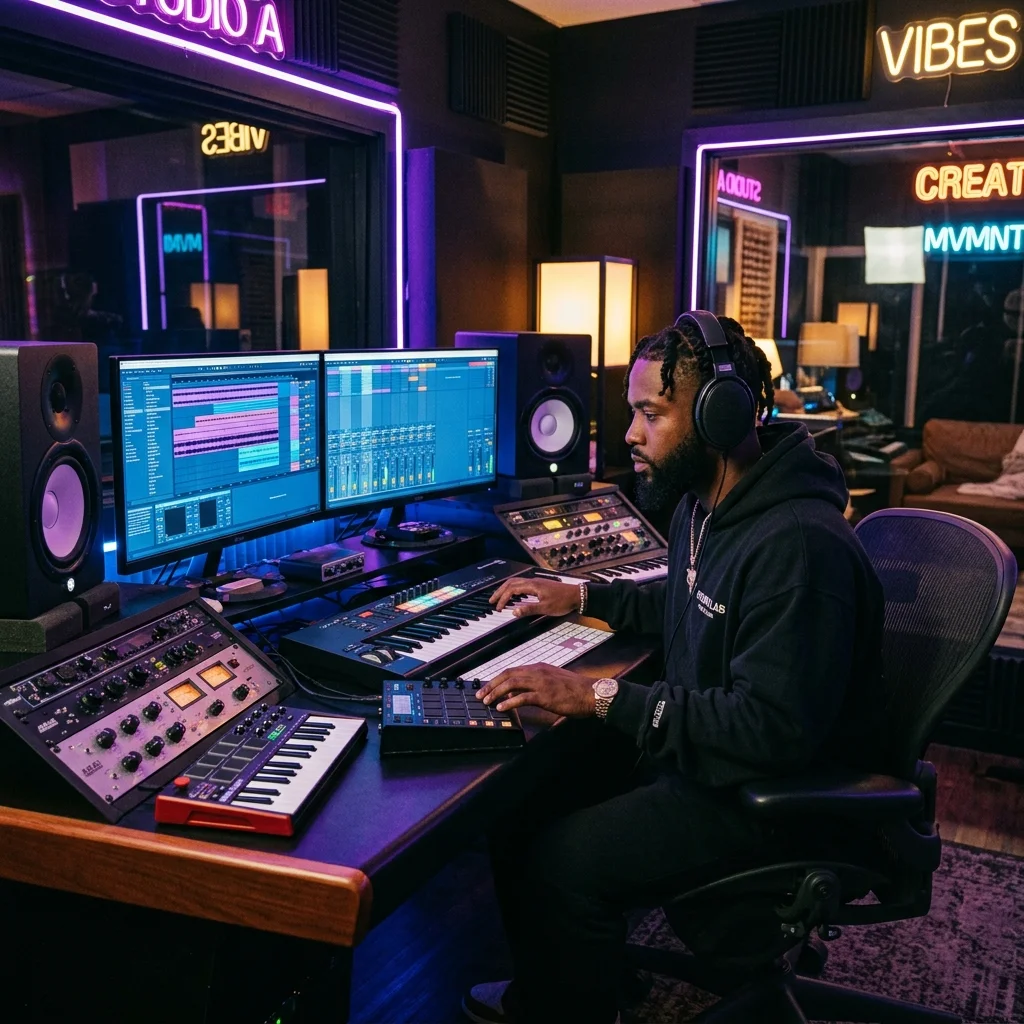
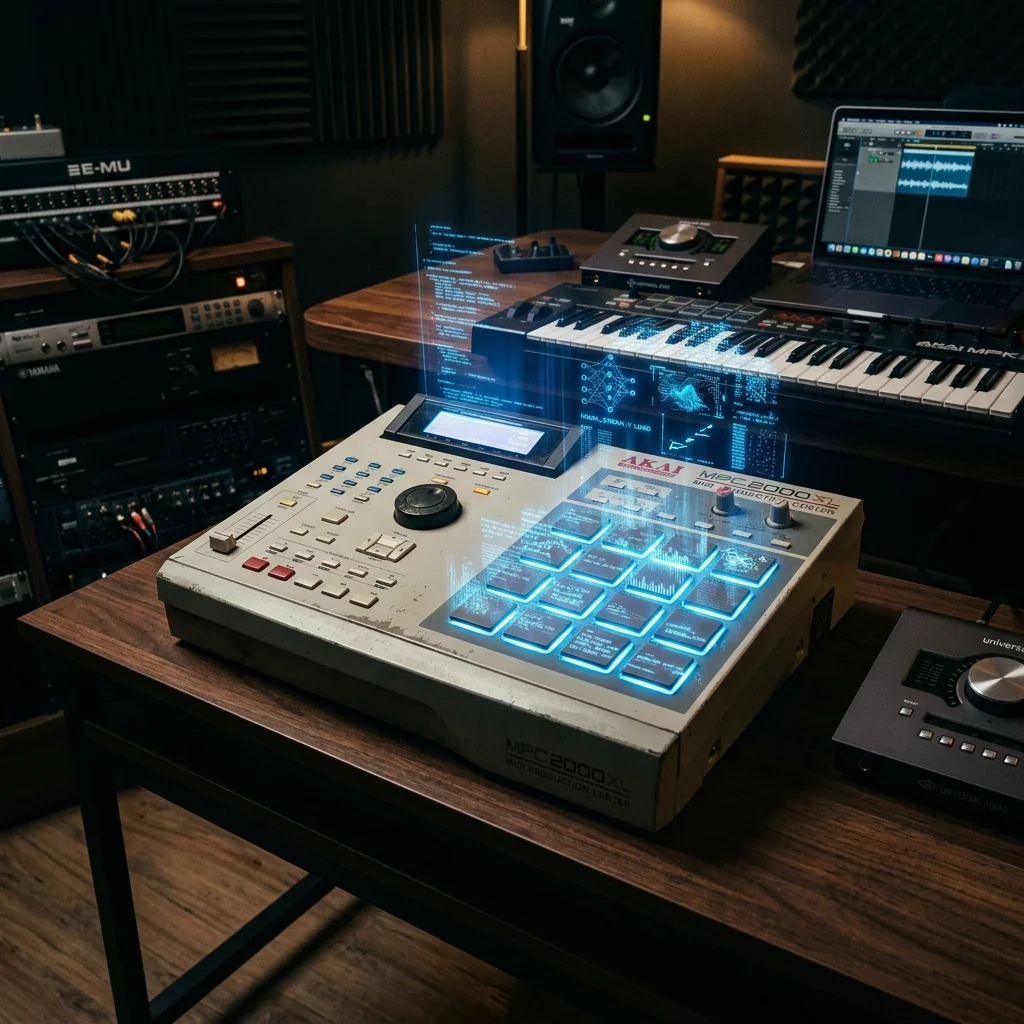
I remember sitting in a dimly lit private studio suite in Atlanta’s Upper Westside in the winter of 2025. The air was thick with the scent of studio-grade incense and cold brew coffee. Super-producer Metro Boomin was hunched over a classic beige Akai MPC 3000. Next to the vintage sampler, a high-end studio monitor displayed a neural-network stem-separation interface. Rather than letting the computer make the creative decisions, Metro dragged a vintage 1971 soul sample into the AI stem separator, extracted the dry vocal, and then physically loaded the vocal slices onto the MPC's grey rubber pads. With a quick tap of his fingers, he triggered a syncopated, unquantized vocal drop over a crushing 808 bassline. It was the exact moment I realized that the dominant narrative surrounding music production was fundamentally wrong. It wasn't an apocalyptic war of Artificial Intelligence versus Human Authenticity. It was a partnership.
For the last three years, pundits and traditionalists warned that generative AI models would completely eradicate the role of the hip-hop beat-maker. They predicted a dystopian 2026 where perfectly quantized, algorithmically generated trap beats would flood Spotify, rendering hardware like the legendary Akai MPC entirely obsolete. The reality, however, is far more nuanced—and far more exciting. The "AI vs. Human" war didn't end with one side crushing the other. It ended in a highly profitable draw.
In 2026, the landscape of hip-hop production is defined entirely by the hybrid workflow. AI didn't kill the MPC; it augmented it. Rather than replacing the iconic hardware that birthed the golden era of boom-bap, artificial intelligence has been integrated into the ecosystem, transforming how producers interact with their equipment, manipulate samples, and structure their creative process.
---
The Evolution of the MPC in 2026
The Akai MPC (MIDI Production Center) remains the absolute cornerstone of hip-hop culture. It is not just a tool; it is an instrument with a profound legacy. The tactile, hands-on workflow of "chopping, looping, and swinging" defined the sound of legends like J Dilla, DJ Premier, and Pete Rock.
If AI is so powerful in 2026, why hasn't the MPC been relegated to a museum?
The answer is twofold: cultural authenticity and hardware integration. Akai did not ignore the AI revolution; they actively absorbed it. Modern updates to the MPC operating system (such as the heavily utilized MPC3 OS) have introduced powerful, AI-driven features directly into the standalone hardware.
The most revolutionary of these features is onboard stem separation. Onboard stem separation is a localized machine-learning audio processing technique that dissects a mixed audio file into isolated vocal, drum, bass, and melodic components in real-time. Previously, if a producer wanted to sample a 1970s soul record but only wanted the bassline, they had to painstakingly EQ the track to isolate low frequencies, often ending up with a muddy, unusable sample. Today, the MPC utilizes localized machine learning algorithms running on dedicated internal DSP chips to instantly, perfectly separate a stereo audio file into isolated stems—all without ever needing to connect to a laptop or cloud server.
This is the hybrid workflow in action: using cutting-edge AI to execute a tedious technical task, which then allows the producer to physically chop and manipulate those pristine stems on the legendary 16 pads using their own human timing.
---
Technical Timing: Roger Linn's Swing vs. Algorithmic Perfection
What makes an MPC beat feel so alive compared to a perfectly quantized computer-generated beat? The secret lies in the timing resolution and the legendary "MPC swing" engineered by Roger Linn on the original MPC 60 and MPC 3000.
Legacy MPC hardware operates at a timing resolution of 96 PPQ. PPQ (Pulses Per Quarter-note) is a unit of measurement used in digital audio sequencing to define the timing resolution and subdivisions of MIDI data.
At 96 PPQ, the micro-timing grid is relatively low-resolution compared to modern DAWs like FL Studio or Ableton Live, which default to 960 PPQ or higher. Because the legacy MPC grid is less dense, the hardware must round (or "quantize") notes to the nearest 96th-note subdivision. When a producer applies swing, the machine shifts every second 16th-note in a pattern slightly late.
A swing setting of 50% is perfectly straight timing. A setting between 54% and 62% shifts the off-beat 16th-notes by a precise number of clock pulses, creating the famous, lazy groove that defines East Coast boom-bap.
In contrast, AI-generated MIDI humanizers try to simulate swing by applying random timing offsets (jitter) to notes on a high-resolution 960 PPQ grid. This random jitter lacks the mathematical consistency and grid-rounding characteristics of Roger Linn's 96 PPQ engine. This is why AI-generated grooves often sound messy or disjointed rather than naturally swung. Human producers use the MPC to dial in this precise, legacy timing engine while letting AI handle the heavy spectral cleaning in the digital audio workstation (DAW).
```
Straight Grid (50% Swing):
[Step 1] ----- [Step 2] ----- [Step 3] ----- [Step 4]
MPC Swung Grid (58% Swing):
[Step 1] ------- [Step 2] --- [Step 3] ------- [Step 4] (Off-beats delayed dynamically)
```
---
The Generative Assistance Era
While hardware integration handles the sampling, how is AI being used in the actual composition process?
In 2026, AI is primarily viewed by professional hip-hop producers as a supportive toolkit, a hyper-competent assistant rather than a lead artist. The initial panic caused by fully generative models (like Suno and Udio) has subsided. While those platforms are incredible at generating background music for YouTube vlogs or corporate presentations, they consistently fail to capture the highly specific, emotionally resonant "pocket" required for a hit hip-hop record.
Instead, producers are using generative AI for ideation and efficiency, completely streamlining the historically tedious parts of the creative process.
A producer might use an advanced AI plugin to generate a complex, multi-layered jazz chord progression. They don't just drag and drop that progression into the track; they feed it into an analog synthesizer, manually tweaking the hardware filters and oscillators to give it authentic analog warmth.
Or they might use an AI mixing assistant to instantly balance a rough mix. To maintain real-time responsiveness during tracking, the system relies on high-speed audio interfaces configured for minimal latency, running at a 96kHz sample rate with a 64-sample buffer size, which yields a round-trip latency of just 2.3 milliseconds. This prevents any noticeable monitoring delay while the AI dynamics processor analyzes and compresses incoming audio.
This saves the producer three hours of tedious, mathematical EQing and allows them to focus entirely on the creative arrangement and the overarching vibe of the record. The AI acts as the ultimate highly skilled studio engineer, working tirelessly in the background while the human producer acts as the executive director.
---
The "Human" Premium and The Underground Counter-Movement
Interestingly, the proliferation of AI has actually increased the cultural and financial value of traditional, human-driven production. This is known in the industry as the "Human Premium."
Because it is now incredibly easy (and free) for anyone with a smartphone to generate a perfectly in-time, sonically polished hip-hop beat, perfection has become cheap. The market is saturated with flawless, soulless music. As a result, artists and listeners are actively seeking out imperfections.
We are seeing a massive counter-movement in the hip-hop underground that explicitly rejects the "push-button" perfection of AI.
Producers are deliberately turning off quantization, allowing their drum hits to fall slightly off the grid to create a natural, drunken "swing." They are running digital synths through vintage, dusty cassette tape machines to introduce hiss and saturation. They are sampling vinyl records with audible pops and crackles. These imperfections—these specifically human mistakes—are the exact things that an algorithm is programmed to avoid. In 2026, a "dirty" beat produced entirely on hardware holds significantly more cultural cachet than a pristine track generated by an algorithm.
!A classic Akai MPC drum machine glowing with holographic blue AI data streams in a dark studio.
---
The 2026 Hybrid Workflow Breakdown
To survive in the modern industry, a producer must balance the efficiency of the machine with the soul of the hardware. Here is what a standard hybrid production session looks like today:
| Production Phase | The AI Role (Efficiency) | The Human Role (Soul / Authenticity) |
| :--- | :--- | :--- |
| Sample Preparation | Uses AI stem separation to instantly isolate the bassline and vocals from a dense 1960s jazz record. | Curates the specific record to sample; decides which specific 2-second loop has the most emotional resonance. |
| Drum Programming | AI generates a basic rhythmic foundation or helps sort through thousands of kick drum samples to find the perfect acoustic match. | Physically plays the drum pads on the MPC without quantization to inject a unique, slightly off-tempo "swing." |
| Mixing & Mastering | AI plugins instantly clean up background noise, remove harsh frequencies, and provide a balanced rough mix. | Makes creative mixing decisions, such as deliberately distorting the 808 bass or adding vintage tape saturation for character. |
---
Conclusion: Adapt or Die
The future of hip-hop AI is not about replacement; it is about acceleration. The barrier to entry has been completely obliterated. Because AI handles the tedious technical lifting (like EQing and stem separation), a producer’s success in 2026 is no longer determined by their technical prowess, but entirely by their taste.
If your only skill as a producer was making a standard, generic trap beat, you have already been replaced by an algorithm. But if your skill is curation, emotional resonance, and a unique sonic identity, AI has simply given you the tools to work ten times faster.
As we look toward the evolution of hip-hop and the ongoing resurgence of vinyl and the superfan economy, the blueprint for success is clear. The producers who are landing placements in 2026 are not the ones fighting a futile war against the machines, nor are they the ones letting the machines do all the work. They are the ones who have mastered the hybrid workflow. They let the AI handle the data, and they let the MPC handle the soul.
---