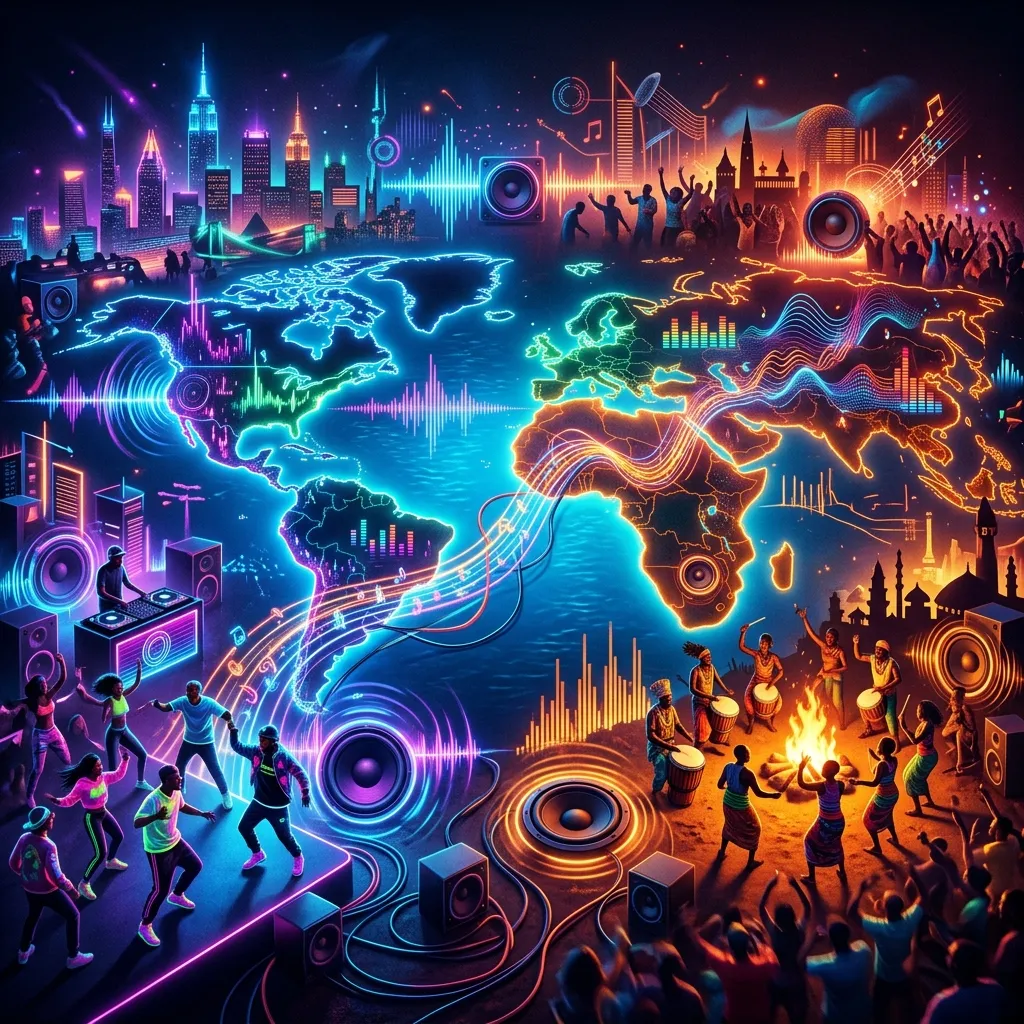
The official 2026 FIFA World Cup album didn’t just blend global genres—it formalized a musical reality that the recording industry has been building toward for half a decade: the absolute global dominance of the Atlanta-Lagos pipeline. The days of Shakira singing solo pop anthems are dead. The new universal language of global sports is trap drums, 808s, and Afrobeat polyrhythms.
When you look at the tracklist for the 18-song compilation released by FIFA to soundtrack the North American tournament, it reads less like a traditional sports compilation and more like a high-budget crossover mixtape. It is a definitive statement that American hip-hop has permanently fused with African and Latin sounds, creating a borderless, reaction-ready genre that is now dictating the rhythm of global culture.
The Atlanta-Lagos Pipeline
To understand the sonic architecture of the 2026 tournament, you have to look at how American hip-hop and Nigerian Afrobeats have cross-pollinated over the last five years.
The turning point wasn’t a sudden corporate decision; it was the organic result of artists realizing that global streaming metrics reward genre fluidity. When Atlanta-based Future teamed up with South African superstar Tyla for the tournament’s lead single, “Game Time,” they weren’t creating something completely foreign. They were formalizing a bridge that artists like Drake, Wizkid, and Burna Boy had already built.
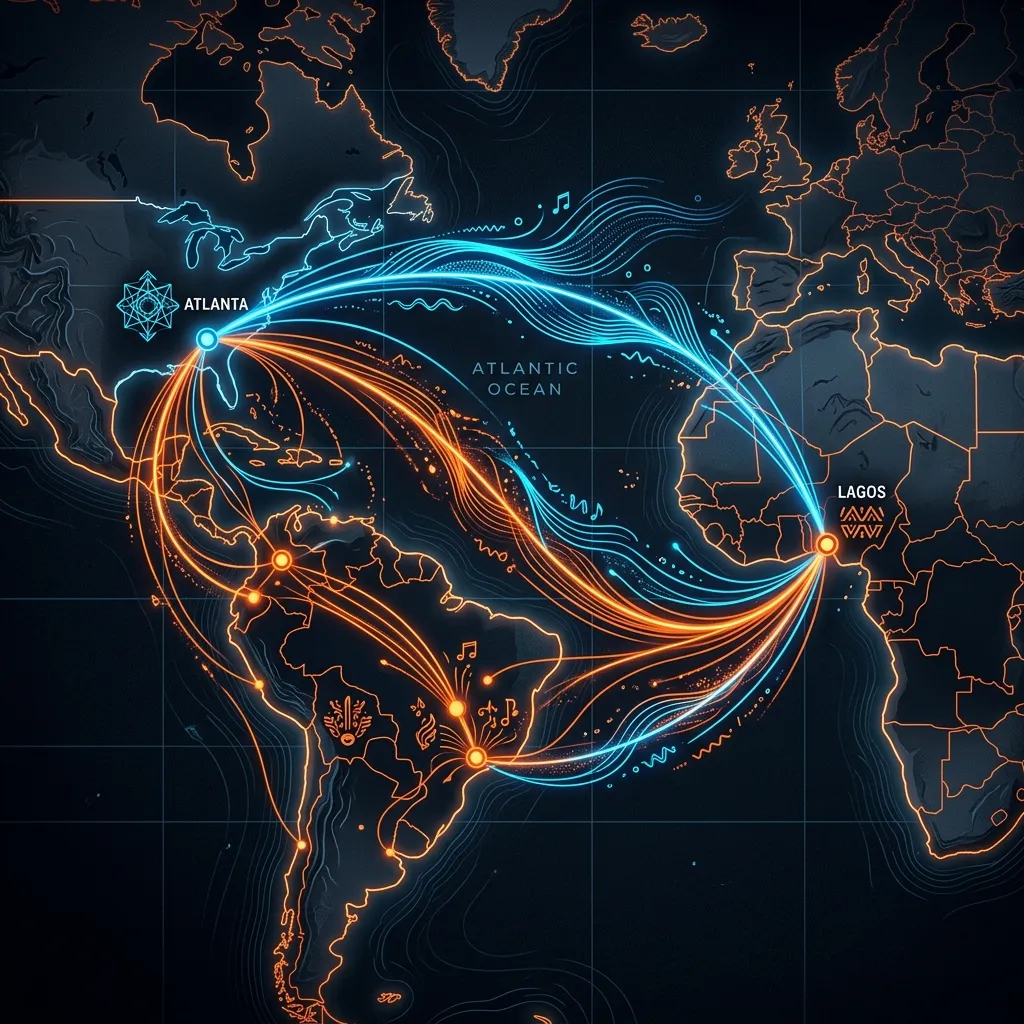 The sonic flow of capital: How Atlanta, Lagos, and Latin America became the axis of global pop music.
The Sonic Anatomy of the Fusion
The drum patterns of modern Atlanta trap music share a deep, fundamental lineage with the percussive elements of West African Afrobeats. When you pair the aggressive, hi-hat heavy production of Southern hip-hop with the melodic, rhythmic cadence of Afrobeats, you create a sound that works simultaneously in a nightclub in Miami, a festival in London, and a stadium in Mexico City.
If you isolate the bassline of a standard track on the 2026 World Cup album, you will often find an 808 glide—a hallmark of Atlanta trap—paired directly with a “shaker” percussion loop native to West African highlife music. This combination is lethal on the global charts because it satisfies the Western desire for heavy bass while maintaining the syncopated groove required for international dance challenges.
The Data Behind the Cross-Pollination
Why did FIFA abandon traditional European pop music for this specific cultural fusion? The streaming data made the decision for them.
When you compare the streaming velocity of traditional pop anthems against the new wave of cross-continental hip-hop/Afrobeat collaborations, the ROI for FIFA’s marketing budget is undeniable.
| Metric | Traditional Euro-Pop Anthem | The Hip-Hop/Afrobeats Fusion Model |
|---|---|---|
| Primary Streaming Markets | Europe, UK | North America, Africa, LatAm, UK |
| TikTok Engagement / Virality | Low (Requires manufactured trends) | High (Organic dance/reaction culture) |
| Demographic Appeal | 35+ (Nostalgia driven) | 16-28 (Culture drivers) |
| Global Playlist Placement | Limited to Pop / Sports | Rap Caviar, African Heat, Today’s Top Hits |
| Cultural Longevity | 1 Month (Tournament duration) | 6-12 Months (Club/Radio rotation) |
FIFA recognized that a track featuring Burna Boy and Shakira, or Ayra Starr and Latto, doesn’t just get played before a soccer match. It gets played in every major cultural hub on Earth for the next year.
Case Study: Ayra Starr and Latto’s “Show Me”
Take the track “Show Me” from the official World Cup album, featuring Nigerian singer Ayra Starr and Atlanta rapper Latto. The song didn’t just perform well in the United States; it debuted at number one in Nigeria, South Africa, and surprisingly, Brazil.
This illustrates the true power of the fusion model. Latto’s presence guarantees placement on Rap Caviar and heavy rotation on US urban radio. Ayra Starr’s presence guarantees dominance across the entire African continent and massive engagement in the UK Afrobeats scene. By combining the two, FIFA essentially hacked the global streaming algorithm, ensuring the song was inescapable regardless of geographic location.
The Formalization of “Global Pop”
What the 2026 World Cup album ultimately achieved was the redefinition of “Global Pop.”
For decades, the global music industry treated American hip-hop as an export—something the US produced and the rest of the world consumed and imitated. Concurrently, it treated African music as a “World Music” niche, something exotic to be sampled but rarely centered.
The 2026 tournament flipped that dynamic. It proved that hip-hop is no longer just an American export; it is a shared global framework. By placing artists like 21 Savage, Stormzy, and French Montana on the same project as the biggest stars in Latin America and Africa, FIFA highlighted that these genres are no longer operating in silos.
The Erasure of Borders
The American artists brought the sheer commercial weight and the aggressive sonic edge; the international artists brought the rhythmic complexity and the global melodies. Together, they created a soundtrack that finally felt as diverse, gritty, and unpredictable as the tournament itself.
In the studio, borders no longer exist. An artist in London can send a drill beat to a rapper in New York, who forwards it to a vocalist in Lagos for a hook. The 2026 World Cup was simply the first time a major global corporation realized that this borderless, decentralized approach to hip-hop and Afrobeats was the most effective way to market to the entire planet simultaneously.
The Role of Latin American Reggaeton in the Tri-Continental Fusion
While the Atlanta-Lagos pipeline formed the rhythmic foundation of the 2026 World Cup album, it would be a critical oversight to ignore the third pillar of this global fusion: Latin American Reggaeton.
The tournament was co-hosted by Mexico, which inherently demanded a massive Latin sonic presence. But rather than isolating the Latin artists on their own separate tracks, the producers of the official album wove them directly into the Hip-Hop/Afrobeats framework.
The foundational “dembow” rhythm of Reggaeton (a syncopated 3-3-2 drum pattern) acts as a perfect mathematical bridge between the rapid, stuttering hi-hats of Atlanta trap and the complex, polyrhythmic shakers of West African highlife. When you combine all three, you create a song that is almost scientifically impossible not to dance to.
Tracks featuring artists like Bad Bunny or Peso Pluma were not traditional Reggaeton or Corridos Tumbados; they were cross-pollinated experiments featuring trap 808s and African vocal samples. This tri-continental fusion proved that the global south and the American south have more in common musically than they do with the traditional European pop centers that historically dominated World Cup soundtracks.
The Major Label Bidding Wars of 2026
The immediate aftermath of the World Cup album release triggered a frantic realignment within the major record labels (Universal, Sony, Warner).
Prior to 2026, the A&R (Artists and Repertoire) departments at major labels were generally siloed by geography. The “Urban” department handled Atlanta trap, the “Latin” department handled Miami and Puerto Rico, and the “African” divisions were often treated as specialized, emerging markets.
The massive, undeniable streaming success of the World Cup’s cross-genre tracks completely shattered those silos. Executives realized they were leaving hundreds of millions of dollars on the table by keeping these genres separated. Within weeks of the tournament concluding, a massive bidding war erupted for producers who possessed the specific skill set to seamlessly blend trap, Afrobeats, and reggaeton.
Producers who were relatively unknown outside of their local scenes were suddenly being offered multi-million dollar publishing deals, provided they could act as the architectural bridge between a rapper in Atlanta, a singer in Lagos, and a vocalist in Bogota. The 2026 World Cup didn’t just change how sports sounded; it fundamentally restructured how the global music industry signs and develops talent.
Frequently Asked Questions
Which hip-hop artists were on the 2026 FIFA World Cup Album?
The 2026 World Cup official album featured heavy involvement from the hip-hop community, including major tracks from Future, 21 Savage, Latto, Stormzy, and French Montana.
How did Afrobeats influence the 2026 World Cup music?
Afrobeats and African pop music were central to the 2026 World Cup’s sonic identity, with artists like Tyla, Burna Boy, and Ayra Starr collaborating directly with American hip-hop artists to create globally appealing, rhythmic anthems.
Why did FIFA move away from traditional pop anthems?
FIFA shifted away from traditional pop anthems to capture a younger, more diverse global audience, leveraging the massive streaming power and TikTok virality associated with modern hip-hop and Afrobeats culture.
What is the Atlanta-Lagos pipeline?
The “Atlanta-Lagos pipeline” refers to the highly successful, organic collaboration and sonic blending between Southern American hip-hop artists (centered in Atlanta) and West African Afrobeats artists (centered in Lagos), resulting in a dominant global pop sound.
How does modern Trap music relate to Afrobeats?
Both genres share a heavy reliance on complex percussive rhythms. Modern trap music often utilizes 808 sub-bass glides, which pair naturally with the syncopated “shaker” percussion loops and highlife elements found in traditional and modern Afrobeats.