The Numbers Do Not Lie
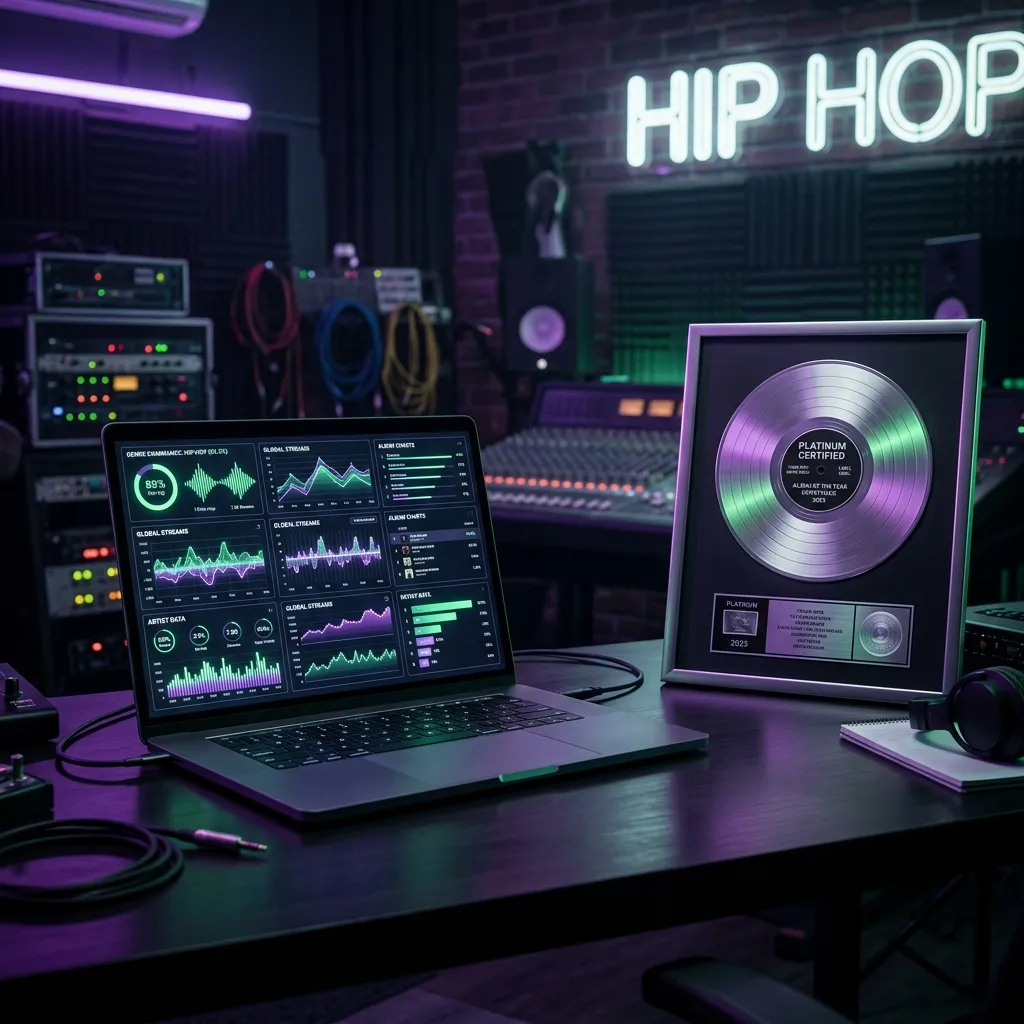
When our editorial team gained access to a proprietary streaming analytics dashboard earlier this year, the sheer scale of hip-hop’s digital footprint was staggering. We were analyzing a mid-tier regional rapper from Detroit who had virtually no mainstream radio play and zero Billboard Hot 100 entries. Yet, according to the backend data, his catalog was generating over 4 million streams a week across Spotify and Apple Music, pulling in a demographic that stretched from Michigan to London to Seoul.
In 2026, hip-hop is not just a popular genre; it is the structural foundation of the global streaming economy. The music industry has historically viewed rock, pop, and country as the primary revenue drivers. However, when the world transitioned from physical CDs to digital streaming platforms (DSPs), hip-hop capitalized on the shift faster and more aggressively than any other genre in history.
This comprehensive guide takes a deep dive into the 2026 streaming data. We will explore the exact metrics behind hip-hop’s dominance, how the genre’s structure is uniquely optimized for algorithmic growth, and what the increasing competition from global genres means for the future of rap.
Why Hip-Hop is Structurally Built for Streaming
To understand the dominance, you must understand the architecture of the music. Streaming platforms like Spotify are designed to reward volume, frequency, and retention. Hip-hop is uniquely positioned to dominate the streaming market because its culture encourages rapid, constant content output and high-volume collaboration, perfectly aligning with the algorithms that prioritize consistent user engagement.
While a traditional rock band might spend three years writing, recording, and mixing a 12-track album, a hip-hop artist can record a 15-track mixtape in a month and immediately upload it. This structural advantage allows hip-hop artists to dominate the “Release Radar” algorithms, staying constantly visible to their fanbase.
The Demographic Advantage: 2015 vs. 2026
Hip-hop’s streaming dominance was initially built on an “early adopter” advantage. Let’s compare the demographics of the streaming market to see how this advantage has evolved:
| Market Metric | The 2015 Streaming Market | The 2026 Streaming Market |
|---|---|---|
| Primary Streaming Demographic | Gen Z and Millennials (Ages 15-25) | Broadened to encompass Gen X and older millennials |
| Dominant Genres | Hip-Hop, Pop, EDM | Hip-Hop, Latin, Country, K-Pop |
| Pillar Playlists | RapCaviar (Spotify’s fastest-growing) | Specialized micro-genre and mood playlists |
| Global Reach | US-Centric consumption | Massive International consumption (Afrobeats/UK Drill) |
| Artist Strategy | Maximize total track volume (25+ song albums) | Optimize for completion rates and replayability |
Because Gen Z and Millennials were the first to abandon CDs for Spotify, and because those demographics were heavily indexing toward hip-hop, the genre established an insurmountable algorithmic lead early in the streaming era that it still holds today.
Step 1: The Three Pillars of Hip-Hop’s Data Dominance
If you analyze the raw data from 2026, three distinct pillars explain exactly why hip-hop consistently accounts for a massive percentage of the global streaming market share.
1. The Collaboration Multiplier Effect
In rock or pop, guest features are relatively rare events used to boost a specific single. In hip-hop, collaboration is the fundamental basis of the genre. When Artist A features Artist B on a track, that single song is distributed to the algorithms of both artists’ fanbases. If an album has 15 tracks with 10 different featured artists, the album is essentially utilizing the algorithmic reach of 11 different fan bases simultaneously. This cross-pollination creates a massive compounding effect on total stream counts that other genres simply cannot replicate.
2. High Frequency and Mixtape Culture
The algorithm brutally punishes artists who disappear. If a user does not engage with an artist for several months, the platform stops recommending them. Hip-hop’s historical “mixtape culture” naturally trained its artists to release music constantly. By dropping a steady stream of singles, EPs, and guest features between major album releases, hip-hop artists ensure that their algorithmic relevance never dips, keeping their monthly listener counts artificially inflated compared to artists who take years between releases.
3. Cultural Permeability and Genre Fluidity
Hip-hop in 2026 does not exist in a vacuum. The genre dominates because it seamlessly absorbs other genres. A massive percentage of “Pop” streams on Spotify are actually hybrid hip-hop tracks. When a rapper collaborates with a Latin superstar or jumps on a country-crossover remix, those streams are categorized under both genres. Hip-hop’s ability to act as the rhythmic foundation for nearly every other popular genre ensures it captures data from users who might not even consider themselves hip-hop fans.
Step 2: Analyzing the 2026 Market Competition
While hip-hop remains the king of streaming, 2026 data indicates that the market is maturing, and the genre is finally facing legitimate competition.
The Rise of Country and Latin Music
In the late 2010s, hip-hop had a near-monopoly on the Billboard Hot 100 streaming data. However, as streaming adoption broadened to older, more rural demographics in the United States, Country music experienced a massive algorithmic surge. Simultaneously, the global explosion of Latin music (Reggaeton, Regional Mexican) has captured huge portions of the international market share. Hip-hop is no longer the only dominant streaming force; it is now sharing the apex with these rapidly growing sectors.
The Shift Toward Globalization
The data clearly shows that U.S. hip-hop is no longer the sole driver of the culture. UK Drill, African Afrobeats, and Latin Trap are generating billions of streams. The algorithm does not care about borders. Artists like Central Cee (UK) and Burna Boy (Nigeria) are generating streaming numbers that rival top-tier American artists, proving that hip-hop’s dominance is now a truly global phenomenon rather than just an American export.
Best Practices for Leveraging the Data
If you are an independent artist trying to carve out your own market share, you cannot just make good music; you must understand how to leverage the data that drives the industry.
Focus on the “Completion Rate”
As discussed in our previous guides, Spotify does not care if 100,000 people click on your song; they care if those people actually finish listening to it. If you have a 3-minute song, but 60% of listeners skip it after 20 seconds, the algorithm flags it as low-quality content and stops recommending it. Ensure your tracks have an immediate hook or an engaging intro within the first five seconds to secure a high completion rate.
Utilize Spotify for Artists Data
Never guess who your fans are. Use the backend analytics provided by Spotify for Artists. If you notice that your second-highest streaming city is London, you should be targeting your Instagram and TikTok ads heavily toward the UK, and actively seeking collaborations with UK-based producers or artists to capitalize on that specific regional momentum.
Encourage Pre-Saves and Library Adds
The most valuable metric you can generate is a “Save” or a “Library Add.” This tells the algorithm that a user wants to establish a long-term relationship with the song. When promoting your music on social media, do not just ask fans to “Listen on Spotify”; explicitly ask them to “Add the track to your library.”
Common Misconceptions About Streaming Data
The sheer volume of data available often leads fans and artists to draw incorrect conclusions about the health of the industry. Avoid these common analytical mistakes.
Mistake 1: Equating Monthly Listeners to True Fans
A rapper might boast about having 5 million monthly listeners on Spotify, leading fans to believe they are a superstar. The Reality: Monthly listeners are a highly volatile metric. If an artist gets placed on a massive editorial playlist like RapCaviar, they might gain 3 million passive monthly listeners who hear the song in the background but have no idea who the artist is. Once the song is removed from the playlist, the listener count plummets. True fan engagement is measured by follower growth and the stream-to-save ratio, not passive monthly listeners.
Mistake 2: Believing Millions of Streams Equals Wealth
Fans often see a track with 10 million streams and assume the artist is a millionaire. The Reality: At an average payout rate of roughly $0.003 to $0.004 per stream, 10 million streams generates approximately $30,000 to $40,000 in gross revenue. However, if the artist is signed to a major label, they might only see 15% to 20% of that money after the label recoups their advance, pays the producers, and takes their cut. High streams do not guarantee high net income.
Mistake 3: Thinking Algorithms Punish Niche Music
Artists often try to make generic, radio-friendly music, assuming the algorithm only promotes mainstream pop-rap. The Reality: Algorithms actually struggle with generic music because it is difficult to categorize. Machine learning thrives on specificity. If you make highly specific, niche underground music (like lo-fi jazz-rap), the algorithm can easily identify your specific micro-community and push your music directly to the 50,000 people who love that exact sound.
Frequently Asked Questions (FAQ)
What is RapCaviar and why is it so important?
RapCaviar is Spotify’s flagship hip-hop playlist, boasting over 15 million followers. In the 2010s, getting a track placed on RapCaviar was the equivalent of having the number one song on MTV or mainstream radio; it could instantly break an artist globally. While algorithmic playlists are becoming more important in 2026, RapCaviar remains the ultimate editorial co-sign in the industry.
Why do some highly acclaimed hip-hop albums have low stream counts?
Stream counts measure repetition and accessibility, not artistic quality. A dense, lyrical, 15-track concept album might win a Grammy and be hailed as a masterpiece by critics, but because it requires deep, active listening, fans might only listen to it in its entirety a few times. Conversely, a simple, repetitive club track might be streamed 100 times by a single user while studying or working out.
How does the “Pro-Rata” payout system affect hip-hop?
Under the pro-rata system, all subscription money goes into one pool and is paid out based on total market share. Because hip-hop generates such a massive volume of the total streams on the platform, hip-hop artists as an aggregate group take home a massive percentage of the overall revenue pool, effectively meaning fans of smaller genres are indirectly subsidizing the biggest hip-hop stars.
Can an artist manipulate their streaming data?
Yes, but it is highly illegal within the platform’s Terms of Service. This is called “botting” or using “streaming farms”—setting up thousands of fake accounts to play a song on a continuous loop. Streaming services like Spotify and Apple Music use advanced fraud detection software in 2026. If caught, the artist’s music is immediately removed, and their royalties are frozen.
Will hip-hop ever lose its dominant spot on streaming?
It is possible. As global internet access expands, genres with massive international appeal (like Latin music and Afrobeats) are growing at a faster percentage rate than U.S. hip-hop. However, because hip-hop is so adept at absorbing these global sounds into its own ecosystem, it is likely that hip-hop will simply evolve and share the dominant space rather than being completely replaced.
The Future is Data-Driven
Hip-hop’s dominance on streaming platforms was not an accident; it was the result of a culture perfectly optimized for the digital age. The constant output, the collaborative nature of the genre, and its massive appeal to early-adopting demographics ensured that hip-hop built the foundation of the streaming economy.
As an artist or a dedicated fan in 2026, understanding this data is just as important as understanding the music itself. If you want to dive deeper into the mechanics of how this music is discovered, test-marketed, and promoted before it ever hits a Spotify playlist, read our full breakdown on How Streaming Changed Hip-Hop Forever.