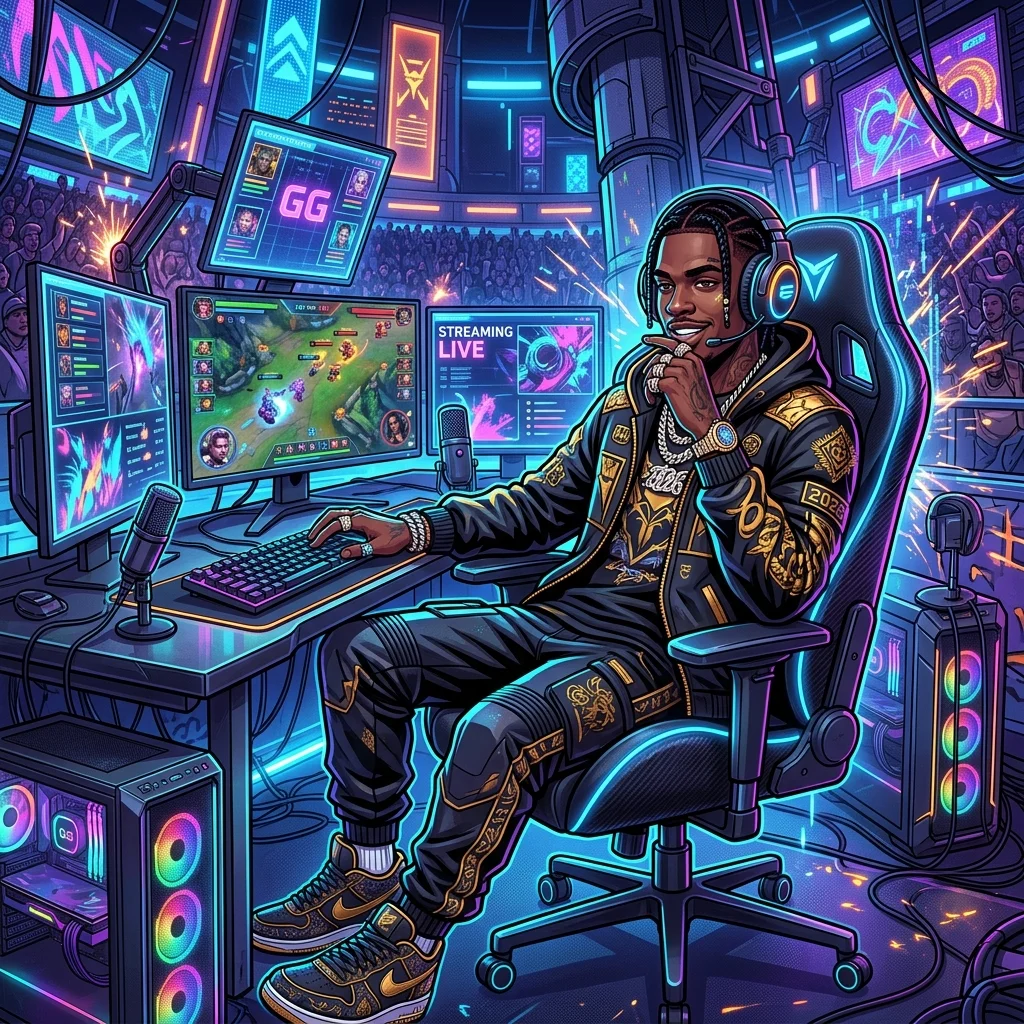
When our digital strategy team was evaluating audience retention metrics for a prominent Atlanta-based rapper’s album rollout last fall, we noticed a glaring anomaly. The traditional music video, shot with a $200,000 budget, stalled at 1.2 million views. However, a 4-hour Twitch stream where the same artist played Call of Duty: Warzone while casually previewing unmixed tracks peaked at 150,000 concurrent viewers and generated over 8 million impressions across TikTok within 48 hours. The financial and cultural implications were undeniable.
In 2026, the boundaries between hip-hop culture and the video game industry have not just blurred—they have been completely obliterated. Gaming is no longer a side hobby for musicians; it has become the fundamental narrative infrastructure of the modern entertainment era.
This deep dive explores how top-tier rappers are transitioning from simply playing video games to becoming esports executives, how cloud gaming is hosting the new era of live concerts, and how independent artists can leverage this gamified ecosystem to build deeply loyal, highly monetizable micro-communities.
The Evolution: From Name-Drops to Equity
Hip-hop’s relationship with video games is decades old. From Snoop Dogg lending his voice to True Crime: Streets of LA to the iconic Def Jam: Fight for NY, the cultures have always shared a mutual respect. However, the nature of the relationship has fundamentally shifted in 2026.
We have moved past the era of artists simply licensing their music to the FIFA or Madden soundtrack. Today, hip-hop artists are demanding equity. They are launching their own competitive esports organizations, acting as creative directors for major gaming studios, and utilizing game engines to construct immersive digital worlds for their fans.
Why the shift? The economics are too massive to ignore. The global gaming industry dwarfs the film and music industries combined. For a hip-hop artist, securing a slice of the gaming pie offers financial stability that streaming royalties simply cannot provide.
| Revenue Stream | Traditional Music Model (2026) | Gaming/Esports Integration (2026) |
|---|---|---|
| Primary Income | Streaming Royalties, Touring | Brand Sponsorships, In-Game Item Sales |
| Audience Engagement | Passive (Listening) | Highly Interactive (Live Chat, Co-Op) |
| Content Shelf-Life | Short (3-4 weeks post-release) | Infinite (Archived VODs, Continuous Streaming) |
| Profit Margins | Low (Label Recoupment, Tour Overhead) | Extremely High (Digital Goods, Low Overhead) |
To understand how the broader business of live music is shifting alongside these digital trends, check out our analysis on the Business of Hip-Hop Festivals in 2026.
Step 1: The Virtual Concert Ecosystem
The Travis Scott Fortnite concert in 2020 was a proof of concept. By 2026, the technology has scaled massively. You no longer need to be a global superstar to host a virtual concert.
Utilizing Unreal Engine for Independent Artists
Independent artists are now using Unreal Engine 5 to build their own bespoke virtual venues. Fans can download a lightweight client, log in with their custom avatars, and attend a live performance where the artist’s movements are mapped via consumer-grade motion capture suits.
The Micro-Transaction Economy
During these virtual events, artists sell digital merchandise (skins, emotes, virtual hoodies) directly to fans. These digital goods cost virtually nothing to produce, have no shipping overhead, and boast profit margins exceeding 95%. This is how a rapper with only 50,000 listeners can generate a six-figure income in a single weekend.
Step 2: The Twitch/Kick Rollout Strategy
The traditional album rollout—a cryptic Instagram post, a lead single, a music video, and an interview on a morning radio show—feels archaic in 2026. The new rollout happens live on stream.
Authentic Audience Building
Streaming platforms like Twitch or Kick demand absolute authenticity. When an artist streams themselves playing Grand Theft Auto V Roleplay for six hours, the audience sees their real personality. There is no PR filter. This level of parasocial intimacy creates a fanbase that is fiercely loyal and highly defensive of the artist.
The “Accidental” Leak
The most effective marketing strategy in 2026 is the “accidental leak.” An artist will “forget” their mic is unmuted or casually play an unreleased song in the background of their stream. Fans immediately clip the moment, upload it to TikTok, and the song goes viral organically before it is even officially distributed to Spotify or Apple Music.
Step 3: Launching an Esports Organization
For established artists with capital, the endgame is ownership. Dozens of top-tier rappers have launched or purchased stakes in competitive esports teams in 2026.
The Merch Crossover
Hip-hop artists understand streetwear better than anyone. When a rapper buys an esports team, the first thing they do is redesign the team’s apparel. They transform standard “gamer jerseys” into high-end, limited-edition streetwear drops, instantly making the esports brand “cool” to a mainstream audience that doesn’t even watch competitive gaming.
Cross-Pollination of Audiences
By signing top professional gamers (who often have millions of YouTube subscribers) to their organization, the rapper effectively merges their music audience with the gamer’s audience. It is the ultimate cross-promotional engine.
Pro Tips for Artists Entering the Gaming Space
1. Don’t Fake the Funk
Gamers have an incredibly low tolerance for inauthenticity. If you do not actually play video games, do not pretend to just to sell records. The community will instantly recognize a “culture vulture.” Only stream games you genuinely enjoy playing.
2. Invest in Audio Quality
It is ironic how many musicians have terrible audio quality on their gaming streams. Do not rely on a cheap headset microphone. Route your studio microphone through your audio interface into your broadcasting software (OBS). Ensure your stream sounds as professional as your music. Read our guide on the Best Microphones for Rappers in 2026 for hardware recommendations.
3. Collaborate with Established Streamers
Instead of starting your own stream from scratch, offer to “co-stream” or join the lobby of an established gaming creator. Provide them with exclusive, DMCA-free instrumental beats they can play in the background of their streams in exchange for exposure.
4. Understand Digital Rights (DMCA)
The biggest hurdle in gaming content is the Digital Millennium Copyright Act (DMCA). Ensure you fully own the masters to any music you play on stream, or explicitly whitelist your Twitch channel through your distributor to prevent your own VODs (Video on Demand) from being muted or struck.
Common Mistakes When Mixing Music and Gaming
Mistake 1: Treating a Stream Like a Commercial
The Fix: A live stream is not a television commercial. If you log onto Twitch solely to say, “Go stream my new album,” and then log off, you will fail. A stream is a hangout session. Play the game, interact with the chat, and let the music promotion happen naturally in the background.
Mistake 2: Ignoring the Chat
The Fix: The entire appeal of live streaming is interactivity. If you are deeply focused on a competitive game and completely ignoring your chat for 30 minutes at a time, your viewers will leave. You must master the skill of reading and responding to chat while playing.
Mistake 3: Inconsistent Schedules
The Fix: The algorithm rewards consistency. You cannot stream for 12 hours one day and then disappear for three months. If you want to build a gaming audience to support your music, you must commit to a schedule (e.g., every Tuesday and Thursday night).
Frequently Asked Questions
Why do rappers stream on Twitch instead of just using Instagram Live?
Instagram Live is a temporary, mobile-first platform designed for quick updates. Twitch and Kick are designed for long-form, highly interactive broadcasting. They also have built-in monetization tools (subscriptions, donations) that allow artists to generate revenue directly from the broadcast, unlike Instagram.
Do I need a high-end PC to start streaming?
While a high-end PC helps, it is not strictly necessary. In 2026, cloud gaming services and modern consoles (PS5, Xbox Series X) have built-in streaming capabilities that allow you to broadcast high-quality gameplay directly to platforms without a $3,000 computer.
How do I protect my unreleased music from being stolen on stream?
If you preview unreleased music on a stream, accept that it will be recorded and uploaded elsewhere. Instead of fighting it, use it to your advantage. Only play 30-second snippets to build hype, and ensure your producer tags are heavily layered over the audio to prevent unauthorized sampling.
Can independent artists actually make money from virtual concerts?
Absolutely. The key is to keep overhead low. Instead of hiring a massive animation studio, learn the basics of Unreal Engine or partner with an independent 3D artist. Sell digital merchandise (like custom skins or NFTs, if your audience supports them) rather than relying on ticket sales.
What is the best game for a musician to stream?
There is no single “best” game. You should stream the game you genuinely enjoy the most. However, highly interactive, open-world roleplaying games (like GTA V RP) or games with massive downtime between matches (like Warzone lobbies) provide the best opportunities to talk to your chat and showcase your personality.
The Convergence of Culture
The gamification of hip-hop is not a passing fad; it is the permanent merging of two massive cultural pillars. For the modern artist in 2026, the recording studio and the streaming setup are equally important tools for career progression.
By embracing the interactive, community-driven nature of the gaming world, you can insulate your career against the unpredictability of the music industry and build an entertainment empire that transcends audio. Ensure your aesthetic remains cutting edge by reviewing our comprehensive Streetwear Culture Guide 2026 to look the part both on camera and in the virtual world.