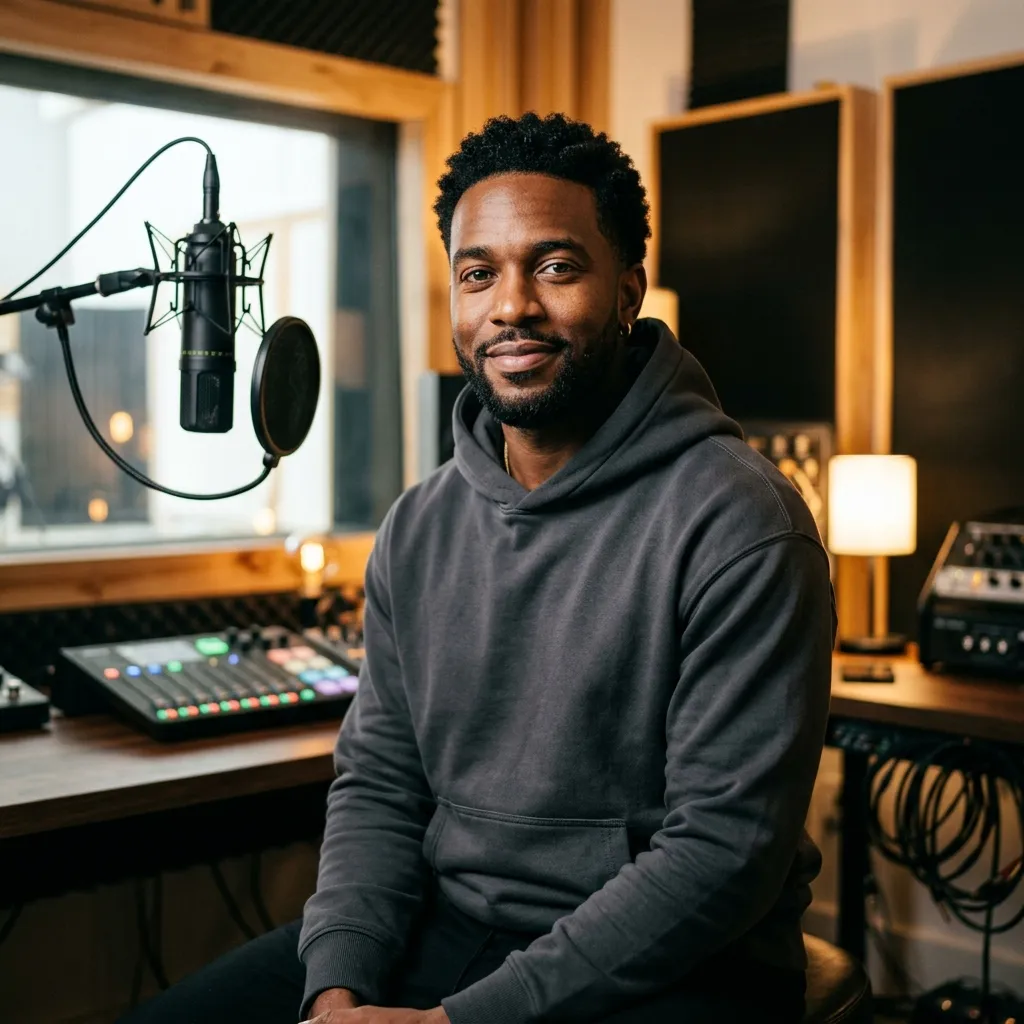
The Machine Enters the Booth
In the spring of 2023, a song featuring the voices of Drake and The Weeknd went viral on TikTok, racking up millions of streams before being abruptly scrubbed from the internet by Universal Music Group. Neither artist had ever stepped into a vocal booth to record the track; an anonymous producer had completely synthesized their voices using artificial intelligence.
That moment was hip-hop’s “Pandora’s Box.” It proved that the technology to flawlessly replicate the most recognizable voices on the planet was no longer locked away in multi-million dollar tech labs—it was available on an average laptop.
Fast forward to 2026, and the intersection of artificial intelligence and hip-hop has moved past the viral shock factor. AI is no longer a novelty; it is a foundational, structural component of the modern music industry. It is simultaneously the greatest tool ever handed to independent producers and the greatest existential legal threat artists have ever faced.
This is a comprehensive look at how artificial intelligence is fundamentally rewriting the rules of hip-hop production, sampling, and copyright law in 2026.
1. The Production Workflow: AI as a Collaborator
While the media focuses heavily on voice cloning, the most profound impact of AI in hip-hop is happening quietly inside the Digital Audio Workstation (DAW).
The Stem Separation Revolution
Historically, sampling was a destructive, messy process. If a producer wanted to sample a snare drum or a vocal run from a 1970s soul record, they also had to sample the bassline and the hi-hats playing at the same time. You could EQ the frequencies, but you could never truly isolate the sound. In 2026, AI-driven stem separation is built directly into DAWs like Logic Pro and FL Studio. A producer can drag a 50-year-old MP3 into the timeline, click a button, and the AI will flawlessly isolate the lead vocal, the drums, and the bass guitar into pristine, separate tracks in under ten seconds. This has launched a new golden era of sampling, allowing producers to flip records in ways that were physically impossible five years ago.
Generative Assistance
Producers are not letting AI make the beat for them; they are using it to bypass creative block. AI tools are now used as “virtual bandmates.” If a producer has a great 808 pattern but cannot figure out the melody, they can ask the AI to generate ten different piano chord progressions in the specific key of the song. The producer then chops, reverses, and manipulates those AI-generated chords to fit their human vision. AI has become the ultimate brainstorming tool.
2. Voice Cloning and The Legal Battlefield
The ability to synthesize an artist’s voice has created a legal nightmare that the court system is still desperately trying to untangle.
The “Right of Publicity”
In the United States, you cannot copyright a voice. You can copyright the lyrics (the composition) and the specific audio recording (the master), but the sound of your voice is not federally protected. To combat AI impersonation, artists and their legal teams are relying on state-level “Right of Publicity” laws, which protect a person’s name, image, and likeness from unauthorized commercial exploitation. In 2026, landmark legislation like Tennessee’s ELVIS Act has explicitly expanded these protections to include an individual’s “voice,” making it a criminal offense to distribute an AI clone of an artist’s vocals without their expressed permission.
The Authorized Licensing Model
Instead of fighting the technology, many artists are now monetizing it. We are seeing the rise of “Authorized AI Vocal Models.” An artist will officially license their voice to an AI platform. Independent producers can then pay a subscription fee to use that artist’s AI voice on their tracks. If the track is officially released on Spotify, the royalty splits are automatically calculated by a smart contract, sending 50% of the revenue directly to the original artist. It allows an artist to “feature” on 10,000 songs a year without ever leaving their house.
3. The Copyright Dilemma: Who Owns the Music?
If an AI generates a beat, who owns the publishing? This question is currently tearing the music business apart.
The “Human Authorship” Requirement
The US Copyright Office has established a firm stance in 2026: Purely AI-generated music cannot be copyrighted. If you type a prompt into an AI generator that says “Make a 140BPM trap beat in the style of Metro Boomin” and it spits out an MP3, you do not own that MP3. Because it lacks “human authorship,” it enters the public domain immediately. Anyone can steal it, use it, or monetize it.
The “Hybrid” Loophole
However, music created through a hybrid workflow is protected. If you use AI to generate a snare sample, but you manually program the drum pattern, play the bassline on a MIDI keyboard, and mix the track yourself, the final composition is copyrightable because there is substantial human creative input. As a result, independent artists are now heavily documenting their studio sessions to legally prove how much human intervention went into their AI-assisted tracks.
4. The Future: The Premium on “Human Imperfection”
When technology allows anyone to generate a perfectly mixed, perfectly pitched, flawless hip-hop track in 30 seconds, perfection loses its value.
The Return of the Raw
We are currently witnessing a massive cultural backlash against sterile, hyper-perfect AI music. As the market floods with synthetic beats, fans are placing a premium on “human imperfection.” Listeners are actively seeking out rappers whose voices crack with emotion, producers whose drum patterns are slightly off-grid (unquantized), and live performances that feature genuine mistakes. In 2026, the flaws are the feature. The “human element” is the only thing an algorithm cannot replicate, and it has become the most valuable commodity in the industry.
The Live Experience
Because recorded music is now saturated with AI, the live concert experience has become the ultimate proof of authenticity. Fans will no longer pay to see an artist lip-sync over an AI-generated backing track. The artists surviving the AI revolution are the ones doubling down on massive, unpredictable, human-led live shows and festival performances.
Frequently Asked Questions (FAQ)
Can Spotify detect if a song is AI-generated?
Yes. In 2026, DSPs (Digital Service Providers) like Spotify and Apple Music use neural “fingerprinting” algorithms that can detect synthetic audio artifacts with incredible accuracy. Artists are now required to disclose if a track contains AI-generated vocals during the upload process.
Is it legal to train an AI on copyrighted music?
This is the subject of several massive, ongoing class-action lawsuits. Major record labels argue that training an AI on their copyrighted catalogs without a license is massive copyright infringement. Tech companies argue it falls under “Fair Use.” A definitive Supreme Court ruling is still pending.
Will AI replace music producers?
AI will replace lazy producers. If your only skill is dragging generic pre-made loops onto a timeline, an AI can do that faster and cheaper. However, AI cannot taste culture, understand regional slang, or read the emotional energy of an artist in the vocal booth. The producers who survive will use AI as an assistant, not a replacement.
Can an AI sign a record deal?
No. An AI is not a legal entity; it cannot sign a contract, open a bank account, or be sued. When you see headlines about “AI artists signing record deals,” the label is actually signing the human creator who programmed and operates the AI avatar.
Embrace the Tool, Protect the Culture
Artificial intelligence is not a passing trend; it is the new electricity. It will power everything in the music industry moving forward. The goal for independent hip-hop artists is not to reject the technology out of fear, but to master it. Use the stem splitters, use the generative chord tools, and use the AI mixing assistants to elevate your workflow.
But never forget that hip-hop was built on human struggle, joy, and lived experience. An algorithm can perfectly replicate the sound of an 808 drum machine, but it can never replicate the soul required to make it bounce.
If you are a producer looking to integrate these new technologies into your workflow, ensure you are using the right foundation by checking out our breakdown of the Top 10 Best Beat-Making Software in 2026.