
Jay-Z selling out Yankee Stadium in July 2026 for the 30th anniversary of Reasonable Doubt isn’t a victory lap—it’s a masterclass in vertically integrated capitalism. While the internet debates whether we’ll ever get the final rock-inspired act of Beyoncé’s trilogy, the Carters are quietly operating entirely above the fray. They aren’t musicians anymore; they are a $3.8 billion private equity firm disguised as hip-hop royalty, and the rest of the industry is still playing a game they abandoned a decade ago.
When you examine the mechanics of their wealth in 2026, the music itself is almost a loss leader. The album releases, the stadium tours, and the streaming drops are simply marketing levers pulled to sustain the valuation of the massive corporate infrastructure they’ve built underneath.
The Myth of the Streaming Check
In late June 2026, Jay-Z released three bonus tracks from 4:44 to all major streaming platforms. Fans celebrated it as a gift. Industry analysts understood it as a targeted algorithm refresh.
To understand the Carter blueprint, you have to accept that a Spotify payout is effectively meaningless to their bottom line. A million streams generates roughly $3,000 to $4,000 in raw revenue before splits. For an independent artist, that’s rent. For the Carters, whose combined household net worth fluctuates between $3.5 billion and $3.8 billion, a streaming check is a rounding error.
They do not release music to collect royalties. They release music to secure cultural real estate, which in turn inflates the valuation of their hard assets. When Beyoncé dropped Cowboy Carter, the goal wasn’t just Billboard dominance—it was cementing the cultural authority required to launch her Cécred hair care line and SirDavis whiskey with zero traditional advertising spend. The music is the funnel; the equity is the endgame.
The Carter Vertical Integration Model
Most artists sign a 360 deal, surrender their masters, and rely on touring and merchandise to survive. The Carters realized early on that wealth isn’t generated by performing a service; wealth is generated by owning the infrastructure that facilitates the service.
This is the definition of Vertical Integration.
Instead of paying a management firm 20%, Jay-Z founded Roc Nation, ensuring he owns the management layer. Instead of begging a label for marketing budget, Beyoncé founded Parkwood Entertainment, retaining 100% creative and financial control. Instead of taking a flat fee to endorse a liquor brand, Jay-Z bought Armand de Brignac and D’Ussé, forcing Live Nation to stock his product at every stadium he plays.
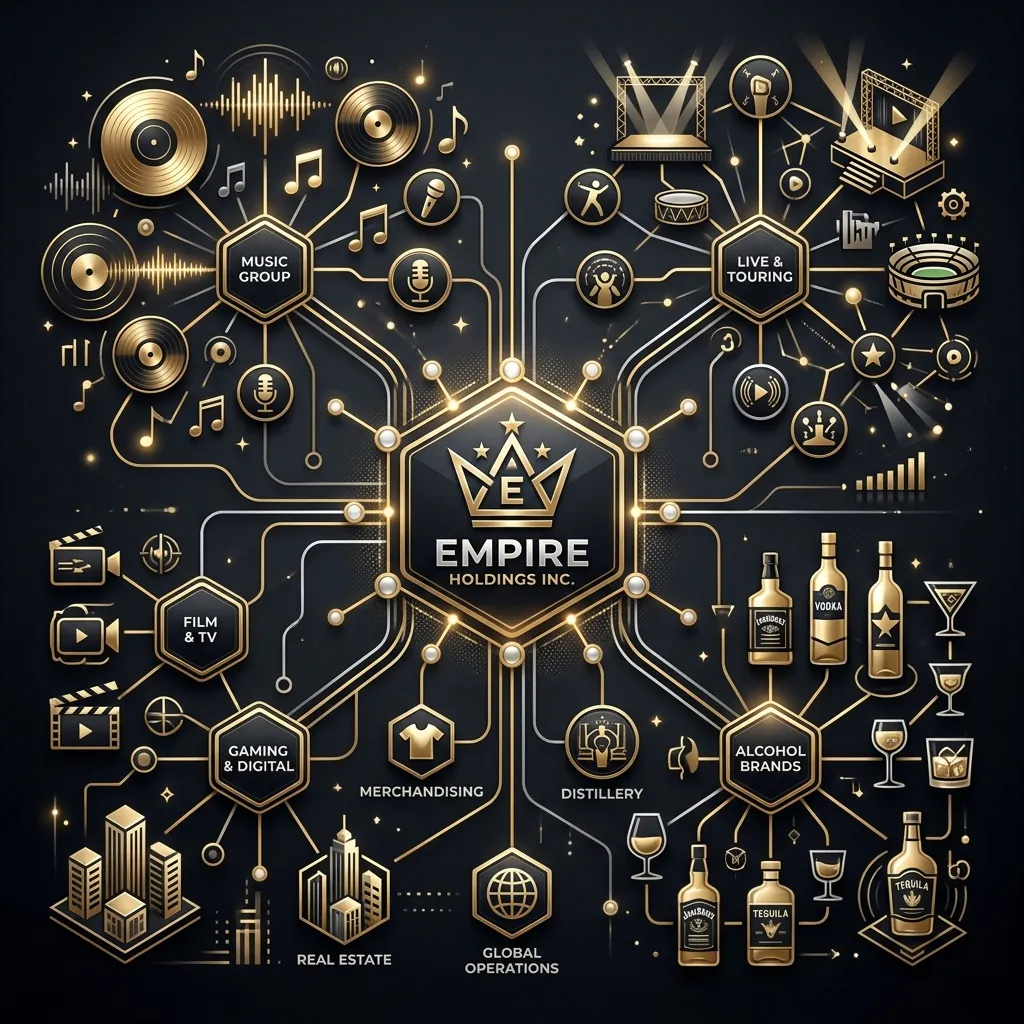 A visual breakdown of the Carter portfolio: Owning the supply chain from production to VIP consumption.
The Economics of Infrastructure vs. Art
To truly grasp how badly the traditional music industry system is broken, we need to compare a standard major label contract against the Carter’s vertically integrated model.
| Revenue Stream | Standard Major Label 360 Deal | The Carter Vertical Model |
|---|---|---|
| Master Recordings | Label owns in perpetuity; Artist gets 15-20% | 100% owned by Artist (Parkwood/Roc Nation) |
| Tour Ticketing | Promoter takes massive cut; Artist gets guarantee | Partnership equity with Live Nation; backend points |
| Merchandise | 360 deal takes 30-50% cut of gross | 100% owned; manufactured via direct supply chains |
| Brand Partnerships | Flat fee endorsement deal ($1M-$5M) | Equity demands only (e.g., Owning the liquor company) |
| Management Fees | 15-20% paid to external management firm | 0% (In-house management via Roc Nation) |
By owning every layer of the value chain, the Carters eliminate the middlemen that traditionally bleed artists dry. Every dollar generated by a Beyoncé tour stays within the Parkwood ecosystem.
The 2026 Masterclass: JAŸ-Z 30
Let’s look at the economics of the “JAŸ-Z 30” stadium shows taking place in the summer of 2026. Jay-Z hasn’t released a solo studio album since 2017. He doesn’t need to.
When he books Yankee Stadium, Stade de France, and SoFi Stadium, he isn’t just selling tickets. Roc Nation, in partnership with Live Nation, controls the booking. The VIP sections are exclusively stocked with D’Ussé and Armand de Brignac. The exclusive merchandise is produced through Roc Nation’s apparel division. The resulting cultural momentum is immediately leveraged into higher valuations for his investments in tech startups and art collections.
The concert itself is essentially a massive, highly profitable commercial for the broader holding company.
What the Next Generation is Getting Wrong
The tragedy of the modern hip-hop landscape in 2026 is that young artists are ignoring this blueprint entirely.
Today’s viral TikTok rappers are obsessed with algorithmic dominance. They chase micro-trends, sign devastating 360 deals for a quick $500,000 advance, and celebrate 100 million streams as if it equates to generational wealth. It doesn’t.
The algorithm is a trap. It forces artists to release disposable music at an unsustainable pace, burning out their creative lifespan while the tech platforms and record labels extract all the tangible value.
If there is a lesson to be learned from Jay-Z and Beyoncé, it’s that true power in the music industry requires stepping outside of it. You cannot reach a billion dollars by selling MP3s or streaming subscriptions. You reach a billion dollars by leveraging your cultural relevance to buy equity in hard assets, controlling your own distribution, and refusing to let anyone else dictate your margins.
Frequently Asked Questions
What is Jay-Z and Beyoncé’s combined net worth in 2026?
As of 2026, their combined net worth is estimated to be between $3.5 billion and $3.8 billion. Jay-Z’s fortune accounts for roughly $2.8 billion, while Beyoncé’s is approximately $1 billion.
Why did Jay-Z release 4:44 bonus tracks in 2026?
Jay-Z released “Adnis,” “Blue’s Freestyle / We Family,” and “ManyFacedGod” to major streaming platforms in late June 2026 to commemorate the ninth anniversary of the album and build cultural momentum ahead of his JAŸ-Z 30 stadium shows.
What is Vertical Integration in the music industry?
Vertical integration is a business strategy where an artist owns the entire supply chain of their career—from the master recordings (production) to the management company, touring infrastructure, and merchandise manufacturing, completely eliminating traditional middlemen.