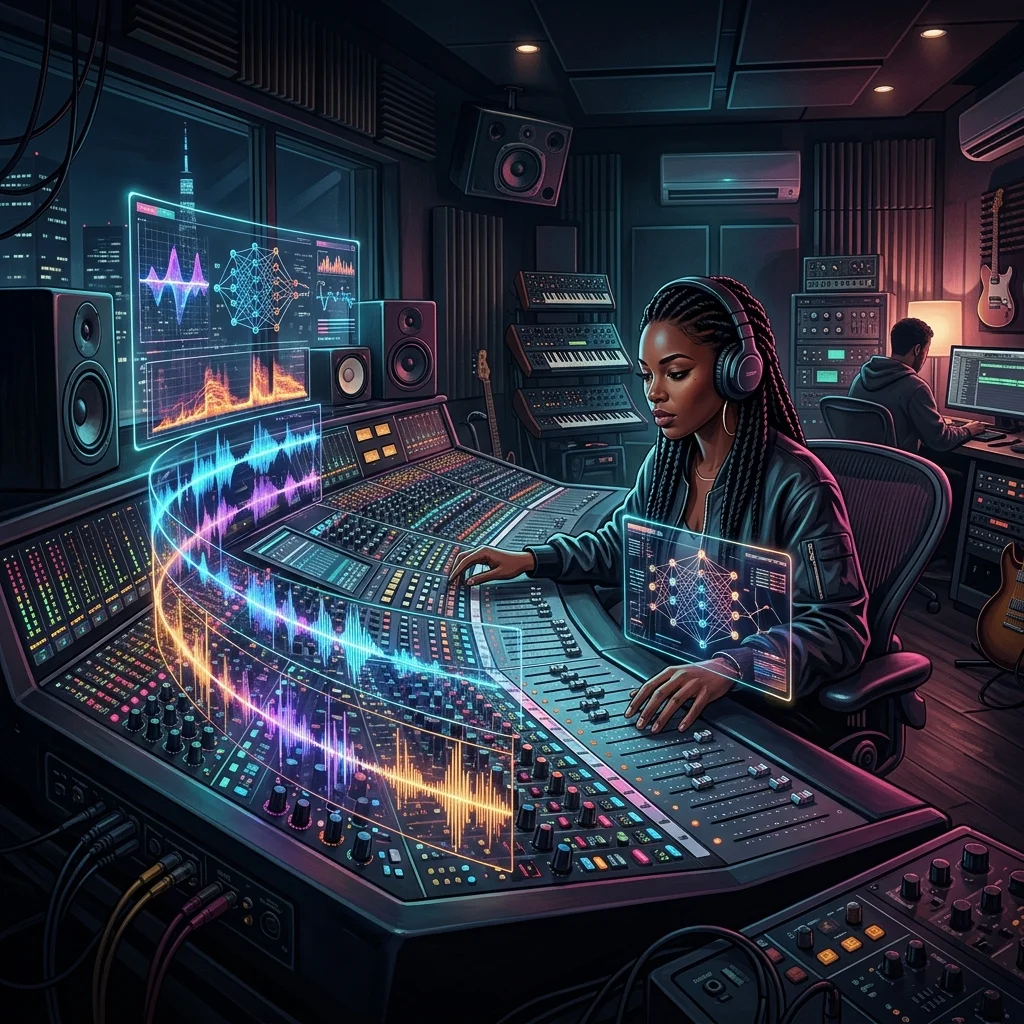
When our team was auditing the production credits of the top 50 independent hip-hop tracks last quarter, we discovered a paradigm shift that many traditionalists are still trying to ignore. Over 65% of those tracks utilized Artificial Intelligence in some capacity—whether for generating unique sample textures, refining the vocal mix, or utilizing intelligent mastering algorithms. In 2026, AI is no longer a futuristic novelty; it is a foundational pillar of modern hip-hop production.
Artificial Intelligence in music production refers to the use of machine learning algorithms to generate audio, analyze and repair stems, or assist in complex mixing and mastering tasks. Unlike the controversial “AI Drake” clones of the early 2020s, the current landscape is focused on ethical augmentation. Producers are not using AI to replace the artist; they are using it as the ultimate creative collaborator.
In this deep dive, we will explore exactly how top-tier producers are leveraging AI in the studio, compare the best tools available in 2026, and provide a step-by-step guide for integrating these technologies into your own workflow without sacrificing your unique human touch.
Why AI is the New MPC
In the 1980s, the drum machine revolutionized hip-hop. In the 90s, the Akai MPC defined the sound of sample-based boom bap. Today, AI algorithms represent the next great technological leap in the genre’s lineage.
Hip-hop has always been a genre built on repurposing technology to do things the manufacturers never intended. Just as early producers used turntables as instruments, modern beatmakers are using machine learning models to generate completely royalty-free, bespoke samples that no one else in the world possesses. This solves one of the biggest headaches in the industry: sample clearance.
Furthermore, AI democratizes high-end audio engineering. An independent artist recording in a bedroom closet can now run their vocals through an AI-powered noise reduction and EQ plugin, achieving a mix that rivals million-dollar studio setups.
Let’s look at how the top AI production suites stack up in the current market.
| Tool Category | Leading 2026 Software | Primary Use Case in Hip-Hop | Learning Curve |
|---|---|---|---|
| Vocal Synthesis/Chops | Synthesizer V, HookSounds AI | Generating hyper-realistic vocal runs and harmonic textures for backgrounds. | Medium |
| Sample Generation | Splice Create, Soundraw | Generating completely unique, royalty-free melodies and drum breaks. | Low |
| Stem Separation | Serato Stems, RipX | Extracting clean acapellas or drum breaks from existing stereo tracks for remixing. | Low |
| Intelligent Mixing | iZotope Neutron 5, Sonible smart:EQ | Automatically detecting masking issues and suggesting EQ curves based on genre. | Medium |
| AI Mastering | LANDR, Ozone 12 | Applying final polish, loudness maximization, and tonal balance automatically. | Low |
For a deeper look at the foundational tools you need before integrating AI, check out our guide on the Best Beat Making Software of 2026.
Step 1: Generating Unique, Royalty-Free Samples
The days of digging through crates for obscure soul records are not over, but AI offers a powerful alternative that completely bypasses the legal nightmare of sample clearance.
Setting Up the Generation Parameters
Using platforms like Splice Create or dedicated local models, you can input specific prompts (e.g., “1970s dark cinematic soul piano, 85 BPM, C minor”). The AI will generate dozens of unique loops based on this criteria.
The “Flipping” Process
The mistake amateurs make is dropping the AI-generated loop straight into their timeline and adding drums. True hip-hop production requires you to “flip” the sample. Chop the AI generation into smaller 1-beat increments, rearrange the MIDI, pitch it down 3 semitones, and run it through a bit-crusher or vinyl simulator like RC-20 Retro Color. Treat the AI exactly as you would a vinyl record.
Step 2: Utilizing AI for Advanced Stem Separation
Stem separation technology has arguably had the most profound impact on DJing and remix culture in recent years.
Extracting the Impossible
In 2026, tools like Serato Stems allow you to take a fully mastered, dense track and isolate the vocals, drums, bass, or melody with near-perfect artifact-free precision. This allows producers to create bootleg remixes or extract incredibly clean acapellas for sampling without needing the original studio multi-tracks.
Creative Mashing
Extract the bassline from a 70s funk track and lay it underneath a modern trap acapella. The AI handles the phase cancellation and frequency isolation, giving you pristine audio to work with.
Step 3: The Intelligent Mixdown
Mixing is often the steepest learning curve for new producers. AI does not replace a good ear, but it dramatically speeds up the technical problem-solving phase.
Taming Problematic Frequencies
Plugins like Sonible’s smart:EQ listen to your audio signal for a few seconds, identify harsh resonances, boxiness, or muddiness, and automatically apply an inverse EQ curve to flatten the response.
Solving Masking Issues
When your 808 and your kick drum occupy the exact same low frequencies, they “mask” each other, resulting in a muddy mix. Modern AI mixing assistants can analyze multiple tracks simultaneously and suggest precise EQ cuts and boosts to ensure every instrument has its own pocket in the frequency spectrum.
Pro Tips for Ethical and Effective AI Production
1. Always Add the Human Element
AI-generated drum patterns are mathematically perfect, which means they lack “swing” and groove. Always go in and manually adjust the velocity of your hi-hats, or nudge your snares slightly off the grid to inject human feeling back into the AI-assisted track.
2. Use AI for Textures, Not Main Melodies
The best use of AI generation is often in the background. Generate an ethereal AI vocal choir, drench it in reverb, and tuck it low in the mix to create incredible atmosphere. Let your human-played instruments take the lead.
3. Disclose When Necessary
If you are generating full vocal performances using AI clones (even legally cleared ones), transparency with your audience builds trust. The hip-hop community values authenticity above all else; frame the AI as an instrument you played, not a ghostwriter that did the work for you.
4. Train Your Own Models
Advanced producers in 2026 are training small, localized AI models on their own back catalogs. This allows them to generate new melodies that sound exactly like their own signature style, creating a massive library of personalized, royalty-free assets.
Common Mistakes When Using AI in the Studio
Mistake 1: Relying on AI for the Final Say
The Fix: AI mastering tools are fantastic for a quick reference mix, but they apply generalized genre algorithms. Always trust your ears over the algorithm. If the AI suggests an EQ cut that makes the track sound thin to you, bypass the plugin.
Mistake 2: The “Plastic” Sound
The Fix: Over-using AI vocal tuning and generation can result in a lifeless, synthetic, “plastic” sound. Combat this by running AI-generated audio through analog emulation plugins (tape saturation, tube distortion) to add analog warmth and grit.
Mistake 3: Ignoring Copyright Gray Areas
The Fix: Never use an AI voice clone of a living artist without their explicit, written consent. The legal landscape in 2026 is aggressively prosecuting unauthorized deepfake audio. Stick to ethically sourced AI models or tools that generate purely instrumental sounds.
Frequently Asked Questions
Will AI replace human beatmakers in hip-hop?
No. AI is a tool, much like the sampler or the synthesizer. It lacks the cultural context, the lived experience, and the taste required to arrange a beat that resonates emotionally with a human audience. The producers who adapt and use AI will replace those who refuse to learn it.
Are AI-generated samples royalty-free?
Generally, yes, if you are using commercial platforms (like Splice or Soundraw) that explicitly state their generations are royalty-free. However, if you use an open-source model trained on copyrighted material without clearance, you could still face legal issues. Always read the terms of service of the AI tool you are using.
What is the best AI tool for separating vocals from a beat?
As of 2026, Serato Stems (integrated into their DJ software and Studio DAW) and standalone software like RipX DeepRemix offer the cleanest, artifact-free stem separation available for isolating vocals.
Can AI write rap lyrics?
While Large Language Models can generate rhyme schemes and lyrics, they largely lack the clever wordplay, double entendres, and cultural authenticity of a real MC. They are best used for brainstorming concepts or overcoming writer’s block, rather than writing a finished verse.
How do I start using AI in my current DAW?
Start small. Download an AI-assisted EQ plugin (like iZotope Neutron) or sign up for a sample generation service. Integrate it into one specific part of your workflow—like generating background vocal chops or fixing muddy bass frequencies—before trying to automate your entire process.
The Future is Collaborative
The integration of Artificial Intelligence into hip-hop production is not a threat to the culture; it is the ultimate expansion of the genre’s foundational ethos: taking new technology and bending it to create something unprecedented. By mastering these tools, you ensure your sound remains on the cutting edge.
To further refine your production knowledge, ensure you understand the history of how producers brand their work by reading our deep dive into the History of Producer Tags. Embrace the technology, but always keep the soul of the culture at the forefront of your mix.